Pages

Showing posts with label feminism. Show all posts

Sunday, November 23, 2014

We cannot change the world unless the world wants to change...

Yesterday I spoke to my mom.  It did not go well.  Which is ironic, because I was so excited; I thought I'd come up with a Christmas present to rival the year I gave her Mr. Darcy on DVD.  Well, I say excited but that's not entirely accurate.  I also knew that brilliant as this idea was, my mom almost certainly wasn't going to want it.

With so much build up you're probably expecting something really amazing.  It's not.  I just wanted to buy my mom a dress.  Just a dress.

But the thing is if you know my mom you know that buying her a dress isn't as simple as it sounds.  I have already talked about my mom here.  I've talked about the way she sees herself and how that affects me.  Succinctly, my mother's life is an eternal struggle to conquer an adversarial body.

Nowhere is this more manifest than in my mom's wardrobe.  For the last 15 years my mom has carefully curated a collection of one dress.  The sack.  Not unlike the travesty that is Molly Ringwald's "dress" at the end of Pretty in Pink.
yes, this one, only with shoulders and without lace
To her, "clothing I like" means clothing in colors she likes.  Because styles she likes are non-existent...no, strike that.  There are actually quite a few styles my mom likes.  She actually has a really lovely and distinctive (if rather old fashioned) sense of style.  But you'd never know it to look at her because she wears none of it.  Why?  She's too fat!  It isn't comfortable!  She's too old!  All clothing beyond the shift is off limits to her!
except this pattern is definitely too busy for her...
So this Christmas I thought "Hey!  I happen to know of a great website that will custom build dresses to your exact measurements!  Wouldn't it be great if I were to get my mom a new dress, customized specifically to her that wasn't another of those wretched shifts?!"  It seemed brilliant.  If I could show her that even "fat" people can look good; that the world of pretty clothes that make you feel attractive wasn't forever beyond her; that she can wear whatever she wants!  If I could, with this one dress, open that door even just a crack, then what a magnificent gift I could give her!  So much more than just a dress!
from here, where there are several other cute outfits
But there was a problem.  I couldn't figure out how I could get her measurements any other way but to ask her.  And I knew that if I asked her she would need to know why.  See, I knew that this had to be a surprise because if I were to tell her she would instantly shut me down.  After 60 years, truly she has come to love her prison, if that's not too melodramatic a spin to put on it.  But it is the truth.  She has reasons, she has excuses, she has justifications, but the fact is that my mother is comfortable within her rigid world of body hate.  She knows the rules there (how could she not, she made them herself).  So I knew that at the slightest hint that I was thinking about breaking them she would close ranks and lock down.

But I couldn't figure out how to get those damn measurements.

So I convinced myself I was wrong and maybe she'd see what a great thing this was and suddenly change her personality.  After all, wasn't it smarter to supervise her picking out her own dress rather than risk getting one she hated?

No.  The answer to that question is no.

I called her yesterday morning and told her my plan and exactly what I knew would happen happened.  She shut me down.  She did let me show her the website (after I harassed her) and she managed to find the one sack dress they had.  But I couldn't handle listening to all her justifications for why she wouldn't even try something new.  Not when I had been so excited about this.  I got mad at her and ultimately had to get off the phone.

Because I am angry.

As a person who considers it a fundamental element of my identity that I almost never get really angry, this is important for me to say.

I am angry.

I am angry at my grandfather, whose obsession with arbitrary definitions of physical beauty warped his children's perspectives of themselves for their entire lives.  Every one of them has fought against and hated their bodies from childhood.  I'm angry at a society that both gave my grandfather that arbitrary definition and then told him it was okay to pursue and teach it the way he did.  The society that reinforced his beliefs in my mother's mind and proved to her he was right.  Right or wrong, I'm mad at my mom.  I'm angry that she cannot see through all of this stupidity and just let it all go.  I'm angry she can't see that "this is just who I am" only because she has decided it is.  And I'm angry at myself because I am still fighting the same battle myself.  Because I just had the exact same experience of feeling like I couldn't wear something because my body shape forbids it.  (Side note: I bought the dress anyway and wore it to church today and looked damn good, if I say so myself).  All of these "rules" are the purist form of bullshit and I'm angry that it still exists in the world.

And in the end, I'm angry I couldn't buy a dress and fix my mom's issues with her body.  It's an overly simple idea that obviously would never work, but I wanted it to so badly.
I think this is what I would have gotten her.
Nothing crazy.

Monday, April 8, 2013

My thoughts on the ordination of women

My former roommate Andria has been getting deeply involved in the political sphere.  Pretty much every day my pinterest is flooded with her pins about equality and feminism and all sorts of good things.  She keeps a feminist blog.  She was recently featured as a guest blogger on youngmormonfeminist.org.  She was addressing the current debate about the ordination of women to the priesthood.  Here is the link to her post.  

As I was reading her ideas I came up with some of my own and I wanted to share them.  

Andria is firmly in favor of the ordination of women.  Her post systematically addresses each of the most common arguments against it.  First she addressed the claim "if God wanted women to have the priesthood then they would already have it."  I think she makes a valid point when she says that there have been very clear moments in the history of the saints where God has waited for us to ask before he has given us greater knowledge or light.  She says that perhaps God is waiting to grant women the priesthood, but he is waiting for us to be ready and to ask for that gift.  

As I said, I think she makes a fair point.  And I would look at Elder Holland's talk in this weekend's conference to confirm the principle of asking and questioning that I think many people often forget is fundamental to the LDS faith  (tangentially, just everyone please go and watch that talk again because it was one of the greatest talks I think I have ever heard).  But I think that there is a corollary that comes with that idea that Andria doesn't quite address.  As she says, sometimes the Lord is just waiting for us to be ready.  But...what if we aren't?  What then?  I think Andria would say that that is what the Ordain Women movement is all about.  Getting us ready so it can happen already.  And I can understand that.  But I think it is important to remember the balance--that is, no matter how ready you think the world and the church and the people are, if you truly believe that the Lord is in charge and that the Presidency are abiding by His wishes and it hasn't happened...well...then it isn't time.  I understand how defeatist that might sound.  I don't mean it that way.  All I mean is that, again as Elder Holland said, you have to keep perspective and remember what you do believe.  Don't abandon something you know to be good because it is not yet perfect.  I guess that is what I'm trying to say.  Don't get frustrated if things don't happen as quickly as you want.

Andria addresses men who dismiss the Priesthood as busy work and women who dismiss it as just another responsibility to add to their already maxed out schedules.  I'm slightly bemused at how she tells men who belittle the duties of the Priesthood that they deeply misunderstand the fundamental nature and significance of the authority they wield, whilst simultaneously telling women to calm down because it's not such a big deal in terms of the commitment required.  Be that as it may, I think I can respect at least the hesitancy of women on these grounds.  When I think about the possibility of adding priesthood duties to my life I literally think "awesome...another aspect of my life to feel guilty about for failing to maximize my potential..."  Perhaps it is petty of me to feel that way, but that is, unfortunately, the way I feel.  I don't think I'm "lame" for this.

And lastly, she addresses two points which I am going to combine.  She talks about the "men and women are different but equal" argument and the "men have the priesthood and women have motherhood".  Both of these are, to me at least, essentially rephrasings of the argument that men and women have different strengths and different roles to fill.  She asserts that if women are equal then they should be equally able to care for themselves or their families (or visiting teachees) if they do not happen to have a man handy to take care of the blessing and the household running--as many women do not.  She says that motherhood is not a true compliment to priesthood.  Fatherhood would be the true compliment of motherhood, and priestesshood of priesthood.  She very interestingly points out that motherhood is more a physical ability (no matter how nurturing a man might be and how rejecting of gender stereotypes...he simply cannot bake a miniature human within his lower abdomen; there is no oven there) and priesthood is a spiritual gift and discipline (a woman is absolutely capable of humbling herself and making herself in tune with the spirit).  I think that is a really fascinating distinction that I personally haven't really heard addressed before, and is definitely worth considering further.  

But this was my thought as I read her comments on these issues.  It was actually prompted by my dad and step-mom teasing me.  My dad texted asking me if I wanted the priesthood and I texted back absolutely; eventually we'd manage to excise men from the church entirely.  And I realized that that was actually an important thought.  

I'm going to go all historical on you now and take us all back to high school.  Do you guys remember Plessy v. Ferguson and Brown v. Board of Education?  These were two of those landmark cases you learned about in your social studies class that shaped the history of America.  Specifically, Plessy v. Ferguson and Brown v. Board of Education dealt with the philosophy of "separate but equal" during the time of segregation (were gonna go ahead and pretend that time is past, despite this slightly gratifying (they're forcing change!) and simultaneously vomit-inducing (they even had to have this fight in 2013????) story that recently came to my attention...I just can't get side-tracked by that issue just now).  Essentially, in Plessy the courts legitimized segregation, claiming that as long as everything was equal it was totes fine to keep them dark kids separate from them light kids.  This was in 1896.  60 ish years later, Brown overturned this legal precedent, famously asserting "'Separate but equal' is inherently unequal".  Integration painfully ensued.

Those words.  "Separate but equal is inherently unequal."  I think those words have sunk deep into the American psyche since 1954.  I think they have really been at the heart of the seemingly endless struggle for equality for all the people (all of them...women, gays, blacks, immigrants, whatever).  See, we look at something like Plessy v. Ferguson and we can see exactly how awful that decision was.  There was no equal.   "Separate but equal" meant "We get the nice stuff and you get the shitty reject stuff."  During the days of "separate but equal" everything was horrible.  During the days of "separate but equal is inherently unequal" things started to get better.  And we've spent the last 60 years drilling that into our minds.  If it is separate, distinct, or apart then there is an inequality there.

At the same time, however, somehow that idea has paradoxically been fused with a sort of obsession with personal independence.  Equality has come to mean that every person is able to do every thing for themselves.  If you are dependent on another human being that means that they hold power over you and must therefore consider themselves superior to you.  Sometimes, of course, this means opportunity if not actual ability--"I could definitely learn to be a mechanic if I wanted.  I simply choose to invest my time elsewhere and pay this fellow to mechanic for me."  You get the point though.  Everyone must know they have the option to do everything for themselves if they wanted to.

So when I joked with my dad that ultimately we feminists were going to get rid of all the menz in the church and get things done ourselves it suddenly occurred to me that maybe we should think about that.  The Ordain Women movement is, as Andria said, about granting women the ability to take care of their and their families' priesthood needs themselves.  Which is good, right?  Equality is being able to take care of yourself by yourself.  You don't have to depend on anyone else; no one else has power over you.

Except I can't help but think about the idea of a community of saints.  That is the ideal toward which we are working, isn't it?  A loving, close-knit community of saints who care about and serve each other.  That is the goal.  If we are all striving to become fully independent so that no one needs anyone else, somehow that just doesn't feel like a loving community to me.  So let me ask you this.  What if the reason that women don't hold the priesthood has absolutely nothing to do with their abilities or the lack thereof?  What if it is all about teaching us to come together?  What if the whole point is that you can't do it alone?  Even that single mother.  Maybe the gift she needs isn't that she can bless her children herself; rather it is that some brother in the ward has the opportunity to come serve her and strengthen the bond between them.  

It requires a fundamental shift in perspective to look at the "gender" rolls of the church in this way.  It is a shift from viewing male and female interaction as competitive and antagonistic to complimentary and constructive.  I can understand why such a shift may well be impossible for a lot of women.  I don't think I will ever become a true feminist (a fact which I am completely ok with) because I will never see the battle in every day life like they do.  And I'm glad that they do.  Their efforts have materially improved my life.  But I think that this is an idea worth considering.  "Separate but equal is inherently unequal" may or may not be the great truth we believe it to be, but I submit this: "different but equal" is not the same evil as "separate but equal".  As some banal YA book once said: a key and a lock look completely different to the point that if you knew nothing about them you might never believe that they were companions; indeed, each serves a completely separate purpose.  Yet neither can fulfill that purpose without the other.  Sometimes differences bring us together so that we can combine our strengths and abilities and become better than either of us were apart.  Better than we ever would have suspected had we insisted on doing everything alone.

It is important to understand that I don't have any sort of fundamental problem with the idea of women being ordained to the Priesthood.  I'm a little uncomfortable with the idea of lobbying the leaders of the church to affect changes we think are necessary (aren't we supposed to believe that they're inspired?) but I appreciate the importance of having the debate.  If the first presidency ever comes out with an announcement that women are to be ordained to the priesthood I will not have a problem with that, though I understand many likely will.  But I wanted to share my thoughts on this topic because they feel true and important to me.  I hope they do so to you.

Friday, April 5, 2013

Some thoughts on the terrifying world known as dating

So.  Here's what's going on in my "love life" as they call it.  I met a guy.  He's a really nice guy, taller than me, attractive, clever, interesting, and I just like him.  Cool.  But now we enter the strange nether world that is gender dating dynamics (bonus! at BYU!).  See, I like this guy so my thought is "I should ask him out!"  You know, dates? That really awesome way you can spend some prearranged time with someone you think is cool to learn more about them and decide if you want to spend even more time together to the point where it isn't even prearranged anymore.  And they are learning about you and deciding the same things about you too.  Dates are cool!  Smooches might happen!

Pretty much every guy that I've ever discussed the issue with has come out strongly in favor of girls asking guys out.  They complain that girls have it easy, they don't have to deal with all that rejection and stress and pressure.  They just get to sit back and let all the boys come to them.  And then, of course, they hold all the power.  Who isn't familiar with "nice guy" syndrome?  It's become a very popular topic of conversation on the internet lately.  Nice Guys feel that women are just constantly shutting down perfectly decent dudes because they don't think they're attractive enough; they think they're "creepy" (a catchall word women have basically just turned into an excuse not to go out with a guy); they're just too dang picky; or my favorite...they guy is just too nice and secretly all women love douchbags.  In short, maybe if women started shouldering their fair share of the burden of asking out then they'd realize they need to start giving more guys a chance.

All of this adds up to a pretty clear vote in favor of me asking him out, right?  Oh but wait...

See, I've always been in favor of pretty blunt honesty.  The few times in my life that a bloke has really struck my fancy I generally have been pretty up front about it.  I'm not good at subtlety and I don't like when there's something everyone knows but no one is allowed to talk about.  So if I want to spend time with someone I have no problem being the one to do the asking.  I should be every man's dream girl, right?

But do you know what happens?  I invite a guy to watch a movie or grab dinner or whatever and he gets all kinds of awkward.  Suddenly I'm that freaky, over-aggressive girl who is socially awkward and a little stalker-ish.  Everyone knows one of those girls.  It's like Caleb said today when I asked him how he feels about the girl being the one to do the asking.  He said "I'm ok with it...as long as I like the girl."   Cause see, when guys say they want girls to ask them out, what they really mean is that they'd really like the girls they're interested in to ask them out.  When the girls they aren't interested in ask them out then suddenly it's "Whoa!  What is she doing?  Why is she asking me out?  I never gave her any reason to think I was interested in her.  Why is she forcing me choose between being a jerk and being polite?..."

The thing about that reaction...it's exactly the same thing that is going through a girl's mind when a guy she isn't interested in asks her out.  But what's funny is that guys don't have to deal with it nearly as often as women, so they a have a much poorer response.  It doesn't occur to them that it is possible for them decline politely and kindly.  Instead they freak out, get insanely awkward, and make the offending girl feel like a troll.  (Admittedly, some girls do this too...)

There is some merit to the idea that everyone should be willing to give nice people a chance.  You may not be initially attracted to someone, but I can attest to the fact that you can also find someone more attractive the more you get to know them.  But there's also both a book and a movie called "He's just not that into you"   for a reason.  Because the fact is, if you don't fancy someone you don't fancy them.  Don't be a Nice Guy (or a Nice Girl...they exist).  People are allowed to just not be into you and it is ok.

What I'm saying is this.  Guys, if you want girls to take some more initiative then maybe try to let go some of the stigma that get's associated with an assertive girl.  If she asks you out that doesn't mean she's "aggressive" or a stalker.  I mean, she might be, but the fact that she asked you out should not be the only evidence you have.  And this last bit applies to everyone.  Just calm down.  Asking someone on a date does not need to be such a big deal.  It doesn't mean anything at all besides the fact that someone thinks you're kind of cool and would like to get to know you better.  Which shouldn't be a bad thing.  It should be a compliment.

Sunday, November 11, 2012

The Soul of a Story: Lessons learned from Sunshine

I just finished reading Robin McKinley's Sunshine for the fifth or sixth time.  Every time I reread it it pulls me right back in, even though by now I know exactly what's coming--there are no more surprises left.  Nevertheless, from about the point where Constantine reappears for a second time, I am sucked into the sort of trance that leads to extremely late nights and ditched commitments.  Part of it is the joy of experiencing (at least somewhat vicariously) a new and different world.  It is that sort of book I find myself constantly coming back to, and, I think, a major part of my love of fantasy and science fiction - genres whose entire heart and soul rest upon world-building.  But even the more mundane worlds will do--the vivid charming, and scatterbrained world of Anne Shirley, or the beautiful, treacherous, moralistic world of Elnora Comstock; Victor Hugo's Paris, or Charles Dickens' London; all my favorite books share an ability to engross me in their worlds and call me back if I've stayed away too long.  In books I am able to enter the minds and experiences of the characters.  I can see through multiple perspectives and feel with multiple selves -- a feat I have yet to achieve in reality, though certainly not through lack of trying.  Literature grants me one of my dearest wishes - to get inside the heads of those I care about and to understand what they're thinking.  Sure, the people I'm caring about in these instances are fictional characters, but try telling me that in the moment.  Anyone who's fallen in love with Colonel Brandon, or Elnora Comstock, or Jean Valjean knows that their persistent lack of corporeal form certainly makes them no less real to us.  It simply makes loving them more painful.  A relative or a friend who passes away at least did exist once and you have your memories and your physical connections to them.  A character in a story might be said to live forever, but not in the way that matters to the grieving reader who just finished the book.  That character became a real, complete person in your head who, upon closing that back cover, you're forced to give up; to deny; to remember he or she is merely a figment of your (and the author's) imagination.  And as the prolific existence of sequels and fan fiction tell us, it is a hard and painful loss.  Anyone who has gotten lost in a story knows, just a little I think, the disorientation and pain a schizophrenic might feel upon being told that his delusions were the product of his mind alone.

It is that sort of immersive experience that keeps me coming back to Sunshine.  Even knowing how it all works out and exactly what's going to happen, I still get invested in it.  I care about Sunshine and Constantine.  Not just care about--I feel like I know them.  Even a character so carefully framed to be alien as Con.  The story may be written from Sunshine's point of view and Con may be an impenetrable enigma to her, but to me he makes perfect sense.  This is what I mean when I say that a character is created out of both the author's and the reader's imaginations.  And this is the inverse blessing of fiction; if a character never truly existed then the way he or she exists in your head truly is who they are.  No matter how much detail and how many specifics the author give you in the story (and no matter how completely formed that character is in the author's mind) the fact is that there can never be enough detail in a book or poem or song or movie to tell you who that person is.  Not completely.  You, the audience, are given the outlines, like the empty lines in a coloring book, and then you fill in the rest.  You supply the details, emotions, and motivations that make that character so very real to you.  Thus, he or she becomes at least partly yours.  My Colonel Brandon, my Frodo, or my Constantine are unique from those of my roommates, my mother, my best friend, and the author.  These characters are made up of me, of what I put in them.  And, as my own personal ethereal literary friends, they are just as...accurate as my roommates', mother's, friend's, and the author's versions -- because none of them were ever real to begin with.  There is a particular empathy that avid readers possess - the ability to invest life and reality into fictional people - and I wonder if it is a lack of that ability, that empathy, that divides the non-readers from our ranks?

It was not, however, this investment of personal reality into fiction that most occupied me during this most recent reading of Sunshine.  Rather it was a heightened awareness, a running analysis even, of the actual mechanics of McKinley's writing.  How was she telling this story?  In stereotypically girly fashion, one of my favorite aspects of this story is the tantalizing hints of romance between Sunshine and Constantine.  (We're not talking Edward and Bella here - one of McKinley's greatest strengths as a storyteller is her sense of subtlety and implication)  But I realized, somewhat to my surprise, that McKinley manages something truly amazing in her story; she makes me either forget or simply not care about the implications of that relationship in terms of the consequences to Sunshine's relationship with Mel, a relationship that I am certainly invested in, even if it is not quite to the extent of my investment in her and Constantine.  Those of you who know me or have read this blog know my opinions on infidelity and that "strong" hardly begins to do them justice.  So my lack of concern over this implied potential infidelity all these years fascinated me.  How had McKinley managed to completely subvert my attention  from a theme I am usually so very attentive to?  So I read with heightened attention to the structure of the story itself.  I discovered that I, as the reader, didn't consider the issue because it is never alluded to as such in the book, either by the narrator herself or simply by the structure of her world.  There is, at one point, a narrowly averted sexual encounter between the two (Sunshine and Constantine), and while Sunshine does spend exhaustive amounts of time analyzing the morality of that event and her entire relationship with Con, the conflict comes from the fact that she, as a human, is choosing to consort with him, a vampire.  Never once does she consider her relationship with Con in any sort of connection to her and Mel.  Even in the very brief moment that another person sees her with Constantine and it is alluded to that he, as a male, might pose some sort of threat to Mel it is treated as a joke and instantly forgotten.

I was very intrigued by this...essentially this choice to ignore what would generally be considered a fairly major issue.  As I read I came across others-- rather than deal with the consequences of the climactic battle (or smaller issues, like her avoidance of the fetch put on her) the book simply ends.  Conflicts with Sunshine's mother are referenced, but never actually explained or even shown.  As I was reading, these omissions felt like...cheating?  I felt like McKinley simply didn't talk about things that were "too hard."  But as a finished the book, high on my vicarious-experience buzz, I suddenly wondered "is that necessarily bad?"

That is to say, the more I thought about this book, others of McKinley's books I've previously read, stories in general, and the idea of "cheating" in telling them, I had to acknowledge that it just wasn't that simple.  In a story told in first person like this one, you are bound by certain constraints - namely, you can only share what your narrator would, his or her self, think, know, and say.  You can, of course, get around this to some extent with external stimulus; (the most obvious example being another character who simply asks necessary questions) nevertheless, it is certainly a valid limitation.  In this case, the fact that Sunshine never considered the issue of her potential infidelity to Mel can tell us several different possible things about her --most of which lend themselves to a quite feminist-y reading of her character.

Additionally, inclusion and exclusion are incredibly effective means to highlight certain information and to direct your reader's attention.  I've always maintained that J.R.R. Tolkien's complete silence on the plight of Frodo and Sam during the entire first half of The Two Towers was an absolutely brilliant movie.  He manages to inspire the same fear, anxiety, and burning curiosity to know what's going on in his readers that Gandalf and the rest of the fellowship are all feeling.  What you don't say can actually say quite a lot.  On the other hand, if you don't want your readers to be distracted by extraneous information the best way is simply not to bring it up.  I wrote a post about The Dark Knight Rises and my opinion that one of its greatest strengths was the way it took up a lot the consequences that were ignored or sidestepped in The Dark Knight.  The fact is, if Christopher Nolan had paused now and then to, say, show an angry car owner shaking his fist at Batman as his Prius was demolished it would have distracted from the primary focus of the movie -- even if it had added to the realism.  Those questions and issues were better saved for a different movie.  And so it is with Sunshine.

In the story McKinley created those questions of mine were peripheral and unimportant.  The primary conflict was Sunshine's understanding of her own identity and the then the conflict between Bo and her and Constantine.  These other issues, such as her relationship with Con, with Mel, with her mother, and even with  the SOF, while important, are things better saved for a second novel.  Which, I suppose, brings us all the way back to the beginning of this blog post.  I began by describing the experience of becoming immersed in a story and characters and the mourning that comes when you must leave them behind.  Perhaps, in the end, my "issues" with McKinley's writing, as I reread this familiar story, were actually my long-felt annoyance that she has yet to revisit this world and give me an update on how my old friends are doing....

Wednesday, October 3, 2012

A New TV Obsession...

Matt has been telling me I ought to watch Once Upon A Time for a while now.  This weekend was pretty intense for me, so by Sunday afternoon I just wanted something to distract me and keep my mind occupied so I figured I'd finally give it a try.  Tonight I finished the first episode of the second season, which started on Sunday.  That means that in about two and a half days I watched 23 episodes.  This is why I'm always cautious about letting myself get sucked into new TV shows.
because my brain doing the obsessive equivalent of this is also pretty dangerous...
If you don't know, Once Upon A Time was one of two shows that came out last year that are based on the idea of fairytales in the real world.  The other is Grimm, which apparently was darker and a little bit more subtle.  Haven't watched Grimm and I probably wont.  Once tells the story of Storybrook, a town populated by all the characters of your favorite fairy tales and children's stories (they do branch out from traditional fairy tales with characters like Mulan and the Mad Hatter).  They have been brought into our world, their memories of their former lives erased, by a curse from an evil queen.  Emma Swan, daughter of Snow White and Prince Charming, was the only one spared from the curse and is the only one who can break it and restore the townspeople to their happily ever afters.  The first season centers on Emma, her arrival in Storybrook, and the breaking of the curse.
is it just me or does blond hair just not look right on her?
have a picture of the Mat Hatter too.  Because he's beautiful with perfect hair,
magnificent three piece suits, and delicious guylined puppydog eyes.
While Once, pretty predictably, suffers from some problems with logic and logistics, I think that overall it is a really really well done show.  Matt was quick to point out that it is written by two of the Lost writers (Lost is a show he's been lobbying for me to watch for over a year now) and I think I can see the family resemblance.  There are plenty of twists and big reveals and mysteries.  But what has really impressed me is the quality of the basic storytelling.  I feel like so many TV shows are more concerned with those twists and surprises and keeping people hooked on overinflated drama than they are on actually telling really good stories.  Once, on the other hand, kept up a decent level of storytelling, sometimes caving to cliched plot devices or purely "gotcha!" twists, but overall utilizing some very good thematic development.  Part of this, I think, is a result of the principle of constraint. Which is a principle I just made up, but it's still valid.  Basically, if you tell someone to write a story about anything they'll think a while and then they'll come up with some random story that probably won't be much good and probably will be kind of generic.  If instead, however, you tell them to write you a story using the phrase "Oh, I don't need the dishes", contains a pair of tweezers, and takes place in one single late night then you'll get something rather more interesting (if any of you would like to write me that story, please do and email it to me).  In this case, the constraint was to tell a story fundamentally based on magic in a world that has none.  This really led to some very fun story telling moments and interesting thematic ideas.
because why wouldn't you translate "queen's huntsman"
into "mayor's sheriff and sex-slave on the side"
I will acknowledge my inner feminist for a moment here and say that I also really really appreciate how kick ass the women are in this show.  Snow White, when accosted at her wedding, draws her husband's sword and stands between him and the evil queen Regina.  Little Red Riding Hood? ...well, I don't want to spoil anything, but I kind of have a woman crush on her.  Even more so do I have on one Belle (but we'll talk more about her a little later).  Cinderella begins as a bit of a ditz, but she really grows and finds her strength.  Even Katherine, a proverbial "other woman" who simply exists to come between the two star-crossed lovers, is a really strong good woman who does her best.  And she may be evil, but you can't get much more hardcore than Regina herself.  And last of all is Emma, who is so unrelentingly tough and sure of herself that I'm able to ignore the fact that she is Cameron from House--a feat not to be sneezed at.  These are not your traditional damsels in distress waiting for their men to come save them.  They can and often do save themselves.  I love that so much.
not only is she maximum hardcore, she is also mind-bogglingly beautiful...sorry
Snow White, but you ain't actually the fairest of them all.  Your besty Red is.
But most of all--above all the other characters and all the good story telling and all the fun plot twists--above all that stands my love for one character.  And that character is Rumpelstiltskin, aka Mr. Gold.
so true.
Oh my gosh Rumpelstiltskin.  Matt and I have given many of the characters in the show nicknames, mostly because Rumpelstiltskin is really hard and long to type and then it was fun to give them to the rest.  I call him Skinner.  Which is a perfect name for him because you really never know if he's going to help you or skin the flesh right off your back.
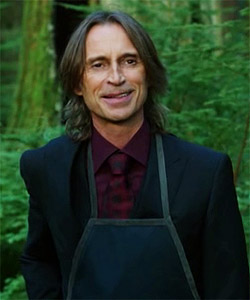
Skinner...why are you wearing gloves and an apron and carrying a
shovel out here in the middle of the woods??
This character is so delectably ambiguous.  Usually, when a character behaves badly in a show it is one of two options: it is a bad character behaving exactly how we expect him or her to act and is therefore boring or it is a good character acting out of character and really stupidly which is immensely irritating.  But Skinner is neither of these.  Skinner is a deeply self-interested character acting incredibly deviously, powerfully, and intelligently to further his own ends.  And sometimes he is just straight up screwing with your head because he's Rumpelstiltskin and what the heck else do you expect?  I love the fact that at any moment he might betray someone and that I don't have to hate him for it because it's just who he is and what the heck, it may end up that that betrayal is actually going to somehow make everything better (sheriff's election anyone?).  One of the things I love most about him is that he's always completely honest.  He'll straight up tell you that he's screwing with you or that the magic you want from him will ruin your life completely.  But somehow, without ever lying, he manages to constantly play with the people around him and keep them all in the dark.
dude, you found a girl who laughs at your horrible jokes...you keep her!
And, unlike Regina with whom I was initially fascinated but have since come to regard as a lost cause, I can't help feeling like Skinner deserves to ultimately be happy.  Which is why I am dying with anxiety over the upcoming season.  Skinner has an opportunity to be with Belle (a truly genius twist on the Beauty and the Beast tale) and let himself be happy.  I want him to take it so very very badly and I am so terrified that he's going to ruin everything as he has so consistently done for himself.  I am more invested in his relationship with Belle then I am in any other relationship in the entire show.
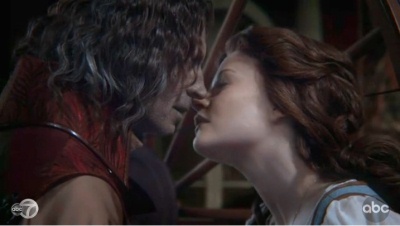
no matter how much  love him I cannot deny that he is a
super awkward kisser...possibly because he has a frog face?
Rumpelstiltskin, aka Skinner, makes  up at least half of my love for this show.  Despite everything I've said, I really can't fully explain how much I love him and why.  I think it's just how very complex and interesting he is.  I'm always a sucker for an interesting guy--a guy who will never ever bore me no matter how well I  know him.  As evidenced by Skinner, this often leads me to take an interest in really hard guys.  That is something I should probably watch out for in my life, but for now it means that I will keep watching this show as long as it keeps giving me plenty of Skinner.  And I'm pretty sure it will...
how can you not love a man who laughs like this?

Saturday, August 25, 2012

Action, Reaction, and Consequence

*DISCLAIMER*
This post deals with really sensitive issues and I understand a lot of people will probably be very upset with me for writing it.  My goal was not to upset anyone, but rather to work through my own thoughts in writing and give others a chance to share their own opinions and experiences.  Also, primarily the situations I am referring to are a limited sample.  That is, I understand that there are plenty of times when the things I'm talking about are completely irrelevant--instances where there is a clear-cut right and wrong and a man very clearly forced himself on a woman against her will.  Please don't think that I am, in any way, trying to dismiss the seriousness of rape or attempted rape or the repercussions it has on its victims.
*DISCLAIMER*

A few weeks ago I had a really intense discussion with my roommate about women's rights, specifically this campaign against the so-called "victim shaming" that sexual assault victims so often experience.  Summer, my roommate, is very passionate about this topic while I had given it little thought, and our conversation really made me stop and think.  Today I read this article by Katie J.M. Baker about why it is important to pay attention to rapists telling their side of the story.  It also presents some very interesting ideas, and, at the risk of painting a target on my back, I would like to share some of my own thoughts.

Over and over throughout the article the point is made that rape isn't just something that happens to modest, virginal girls walking innocently home from class by scary strangers.  It happens to girls with some cleavage showing and lots of leg.  It happens to girls who flirt and tease and fool around.  It happens with guys that girls know.  The point is, even if a girl isn't a demure model of blushing femininity that does not mean that she deserves to be raped.  That word, "deserve," is the key.  No one ever deserves to have something so precious taken from them against their will.  This is the foundation of the fight against victim blaming.  No one deserves to be assaulted, thus your behavior shouldn't matter because no matter what it is...you get the point.

So the fight has been to turn the blame back on the men who are doing the assaulting.  It doesn't matter how "slutty" she dresses or acts, or how convinced you are that really she wants your big bad manliness in her life, the decision to assault her is yours and yours alone.  Women shouldn't have to moderate their behavior because you cannot moderate yours.  It is time for men to grow up and take responsibility for their actions.  No matter what the situation was--no matter what--in the end you were the one who imposed your will on hers, answered your wants above hers, valued your person-hood as being greater than hers.  And don't pull out some bull about how men just "can't help themselves" once they get going.  I think the most surprising part of these men's stories were the men who saw their victims' faces, saw the terror or the pain there, realized what they were doing was wrong, and stopped.  Ms. Baker chooses to focus on the disgusting fact that so few of these attackers even bother to look at their victims in the face, but I'd rather focus on the ones who did and the fact that, too little too late though it may be, these men were able to realize what was happening and stop themselves.  I think there is no stronger argument against the "it's just my nature and I can't help it" than that.

Everything that I have said thusfar I completely agree with.  I stand by it.

And yet...

Having established all of this, I can't help but feel that there is something missing.

The first comment that I saw at the end of this article was from a woman who told her own story of...she didn't want to call it rape.  She explained that she and her friends got drunk and stoned and one of them led her back to the bedroom and they had sex.  She says that she was thinking "no" but she never said it, never did anything to let the man know she wanted him to stop, and even followed him back to the room of her own free will.  She writes about how she doesn't know who to blame--him? herself? her friend who sat by and watched?  She doesn't know.

I think this woman is incredibly brave.  The very next comment is someone assuring her passionately "it's not your fault! It's not your fault!" and telling her to talk to an assault network for support.  They explain that she was not in a state to give consent, and even if she had, since she was so inebriated it wouldn't have "counted," so to speak, anyway.  They are assuring her, essentially, that wherever the blame lies, it is not with her.

But she is not expressing the guilt of a terrorized victim.  Rather, she is looking at the situation, taking all the variables into account, and she is expressing regret that it happened.  And that is why I think she is brave.  Because in a society that is virtually demanding that the blame be heaped upon the head of the man, this woman is willing to say that she shared a part in what happened.  She acted in a certain way, and then she experienced the consequences.

Consequences.  That is what is missing in this story of rape that we have created.

Remember, I do not believe that anyone ever for any reason deserves to have their agency taken from them by another person.  They do not deserve to be treated as an object of gratification rather than a feeling, thinking human being.  No one deserves that.

But actions do not exist in a vacuum.

The fact is, I have always felt uncomfortable with the terms of the fight against "victim blaming".  Women should be able to behave and dress however they want?  I would ask why?  Why should they be given a luxury that no one else has ever been given?

What I see in these debates about rape is a passionate wish to find someone to "blame".  People want something so horrible to be someone's fault.  But blame is a tricky thing.  It is rarely black and white, one or the other.  Nothing happens in isolation, there are always circumstances surrounding it. Women do not ever deserve to be raped, but the fact is that we live in a society.  The way we interact with others tells them how to interact with us.  That is the way it is.  Thus, if a woman behaves in a way that is understood to be encouraging she should not be surprised that men are encouraged.

There is so much that I am thinking and that I want to say, but I think the ultimate point that I want to make is that people seem, more and more, to want their world to exist without consequences.  Women should be able to go out and have a good time without worrying that some slobbering ape of a man will take advantage of them while they're drunk?  But look at it this way--if you are so drunk that you either cannot express your dissent or that you don't even realize that you don't want to, then why is a drunk man supposed to be more responsible?  Pull it even further back--if we, as a society, have embraced a passtime that depends entirely on the lowering of inhibitions and the stripping of our ability to make rational decisions, how can we then be upset when we wake up the next morning to realize that we made stupid decisions?  If we, as a society, reinvent sex as a fun recreational activity shared by friends and strangers, how can we be surprised when some people aren't sure how to take signals and don't know where other people's limits are?

So what am I trying to say?  That we should go back to shaming the victims of assault and assuming that if a girl got "raped" really she was just asking for it and she should stop being such a dang slut?  No.  That's not what I'm saying.  I'm saying, in the end, very much what Ms. Baker was saying.  This is an issue that needs to be discussed.  So many of these men's stories refer to his belief that really she was into it, she wanted him.  We need to find a way to help men understand issues of consent and a way for women to understand issues of communication.  Men: sex is never a given, she can always change her mind, and she has the right to say no.  Women: you are responsible for the situations you put yourselves in, your behavior has consequences, and you cannot expect a person to know anything you do not tell him or her.

One last time, I would like to reiterate that I do not mean to imply that rape is something deserved, or that a person who rapes another person is not ultimately responsible for that decision.  That is the whole point.  We are all responsible for our decisions, no matter how badly we don't want to be.  No matter how much we want events to exist in isolation, they are a part of a whole.  There are actions and there are consequences to those actions.  No matter how badly you want to "blame" someone, to make everything one person's fault, doing so oversimplifies the issue and ignores the real problems.  Everyone needs to take their own responsibility.

Thursday, January 5, 2012

Twilight: slasher fiction for the emotionally starved...

So my friend Danielle and I have this thing where we go and watch whatever Twilight movie happens to be out and we laugh hysterically.  It worked well for Twilight and New Moon.  She was out of the country for Eclipse so I missed that one, but I hear she went and saw it down in Brazil and laughed enough for both of us.  She has recently moved out to New York to be fabulous, but she's back in town for a few days visiting for Christmas so we figured we'd better get us to a late showing of Breaking Dawn 1.0
if your goal is mocking this seems promising, right?

What. The. Hell.

What the hell is that movie?  I'm sorry to be vulgar, but that is really all I can say, over and over.

So, for people like me who had no idea what was going on, here's a rundown.  I actually was just going through doing a play by play but it was taking way too long.  Especially when I realized that this movie is really just four things: wedding, honeymoon, express pregnancy, and delivery.  That's all you need to know.  They get married, they go on a honeymoon, she gets pregnant with the demon baby of death, and then she gives birth to said baby.  And somehow they stretch that into a movie just 3 minutes shy of 2 hours.

But that makes it sound sort of normal.  Oh no.  My first serious "this is wacked out!" alarm went off when she wakes up from her wedding night.  She's all gooey eyed remembering how beautiful it all was and then Edward walks in and asks her how bad she's hurt.  Then he pulls up her sleeves and you see his little fingerprints all over her arms and shoulders.   Suddenly you get a whole new perspective on abusive relationships as you listen to him abjectly apologize for hurting her, swear he never meant to and he'll never do it again, and listen to her get angry with him for...not for hurting her, but for refusing to hurt her even more.  What the what?  He sticks to it for a couple days and all the booty shorts and little negligees in the world won't sway him...until she wakes up from a dream crying cause he just doesn't want her...BLECH!

But that was nothing compared to Gollum!Bella of creeptastic pregnancy emaciation.  The emotional manipulation that happened between her and Jacob.  The bizarre militancy of Rosalee standing guard over PregnantGollum!Bella.  The sippy cup'o'blood to keep sweet li'l baby happy.  The abrupt change in Edward from baby loathing to baby worship.  All of it leading up to a scene that I don't think I'll ever be able to erase from my memory...the Vampire C-Section of Horror.  This is what happens, absolutely no exaggeration.  Bella, Edward, Alice, Rose, and Jacob are having tender bonding times when Bella drops her Cup'o'Blood as Edward hands it to her.  She dives after it and breaks her own back.  She falls, breaking her knees, and is about to splat her little head on the tiles till Edward dashes forward to catch her.  This sends her into labor, but Carlisle is out catching a bite, so it's up to Rose, Alice, Edward, and Jacob to deliver the little one.  Bella is lying there on the delivery table, back still broken, and the rest stand around at a loss till Edward says the baby is suffocating and Bella screams to get him out.  Jacob stands in as the husband, holding her hand and shouting at her to hang in there as Edward snatches up a scalpel and slices open her stomach.  Unfortunately, her uterus has become vampirized and scalpels are useless against it...so Edward rips it open with his teeth!  He comes up with his face covered in in his wife's blood and starts cooing over his new little girl!  Everyone just stands there!  No one thinks "Oh hey!  This woman has just had her stomach and uterus ripped open and may be hemorrhaging out, plus her back is broken.  This may be a good time to vampirize her completely...you know...while she's still alive."  Oh no.  No one even thinks "Oh hey, daddy might want to wipe some of the blood off his face."  They just stare at the baby, watch it take a bit out of it's mother, and coo over how cute it is.  Until Bella stops breathing that is.  Edward finally realizes his wife is in bad shape and hands the baby off to Rose.  He takes out a syringe of "vampire venom" and jams it into her heart.  When that doesn't appear to work he just starts sinking his teeth into her at random, a visual accompanied by a truly cringe-inducing squelching sound.  Nothing seems to be working, and he cries and Jacob cries and Bella looks like dead Gollum.  Oh.  But inside she's becoming a vampire and screaming her head off.  But you can't tell.  She just looks dead and sad.

I would post a picture...but you can't find any
 pictures of a scene that horrifying!  What does
that tell you?

You know what?  Forget the fact that Jacob then imprints on a baby girl.  Forget everything else about this movie--the bad acting, the horrible special effects, even the other questionable plot points.  What the HELL was that scene?  How do people go and watch that and still think that this is a great, beautiful, powerful love story?  What was that!?  I can't ask enough because I can't get an answer.  I walked out of the theatre so disturbed and so confused and so completely creeped out that all I could say was "why did we see that movie again?" over and over and over.

Friday, December 30, 2011

Chess, Mind games, and Infidelity

I'm in one of those hopelessly romantic moods lately.  They come upon me every now and then--wistful romantic yearnings for the passion that my life so distinctly lacks.  Silly moods.

So inspired, I was on the brink of watching Hugh Jackman in Someone Like You.  He has that great scene where he says everything you ever wished a guy would say to you while looking like...Hugh Jackman.  Plus he's delightfully cocky and annoying throughout the rest of the film.  But I decided to give Netflix one last try before committing... (though it has really disappointed me lately with its "Suggestions for you" ideas)

possibly the most adorable picture of
Hugh Jackman ever taken.  Possibly.
I already had Netflix open from where I was searching, quite fruitlessly, earlier today for something good to watch.  By pure luck, when I opened the tab, there was a movie I swear wasn't there before.  I'd never heard of it before, but it had Kevin Kline who I adore.  It was called Queen to Play, and appeared to be in French.  Kevin Kline speaking French?  I am intrigued...tell me more...
yet another entry into the grand tradition
of really wretched movie posters...
Brief synopsis: a French housewife (Helene) is living a drab life working two cleaning jobs, one at a hotel for a demanding boss, the other for a reclusive widowed professor (Kroger played, of course, by Kevin Kline).  She has an average husband (not amazing, but not a jerk) and a typical teenage daughter.  One day at the hotel she sees a couple on the balcony playing an impressively romantic game of chess.  She becomes intrigued with the game, quickly progressing into full on obsession after she buys an electronic set supposedly for her husband.  But the real turning point in her life is when she boldly asks the professor to teach her how to play.  The rest of the movie details the way her new-found passion changes her life.  Her relationships with her husband and daughter are effected, not to mention her job, and most of all, her relationship with herself.

Certainly the movie is crafted as one of those "self-discovery" movies where a repressed woman learns to love and believe in herself.  Sure.  It served that function perfectly satisfactorily.  This is my beef with those movies though; typically for the woman to "find" herself, she has to have some sort of affair with some random man.  What kind of self discovery is that?  The discovery that you lack integrity?  That is a shitty discovery (pardon my vulgarity, but it is the appropriate word) and if that was what you were out to discover, you should have stayed repressed.  Thus, I generally loathe those movies.  (This is where I go on a rant about the movies Serendipity and The Wedding Planner and any other movies based on the idea of infidelity and the fact that when you really really love someone it's ok to cheat on the person you're married to and also happen to only kind of love.  Hmph!)

Alas, this movie pretty much falls into the same family.

but...

About halfway through the movie I almost turned it off.  There was a definite sexual tension developing between Helene and Kroger.  Thus far Kroger has been a disinterested teacher, impressed against his will by her dedication and talent.  But one day they get caught up playing and discover that the day has passed them by and it is well past Helene's usual time of departure.  No big deal...except instead of going home Helene decides to stay and they have a drink.  They sit...they talk...they stop talking...and still she stays, just staring levelly at him.  Eventually you see him start getting ideas.  You really can't blame him.  She just keeps staring at him.  Just as he's about to say something, however, she gets up.  A moment later she is standing in front of a picture of his wife and he joins her.  He reaches up and touches a strand of hair and asks if she changed it.  Yes she has...and she'd better go home now.  Yes, yes she probably should...

That is usually the point where I start getting annoyed and turn the movie off.  I really don't tolerate unfaithfulness.  But I found myself in an interesting predicament.  Not only did I want to see how it all ended, but I really wasn't sure how it would.  So I kept watching.

Just so you know, the only person Helene has sex with during the movie is her husband (and lest you worry, you don't see much...the movie is rated PG).  That being said, I still would definitely say Helene cheats on her husband.  But I was fascinated with the nature of her infidelity--she has an affair of the mind, rather than one of the body.

The idea of cheating is definitely overt.  Her husband gets suspicious and follows her at one point, expecting to see her and Kroger in the midst of an embrace and is bewildered to see them sit down at the chess board.  He confronts her later and declares he'd almost rather she was having an affair.  It is clear that what is being seduced is not her flesh, but her mind.  The two of them, Kroger and Helene, are both excited by the stimulation the other gives to their mind.  Kroger several times refers to the rest of the world as idiots, pointedly excluding her from this condemnation.  Helene tries to share the game with her husband but he simply can't understand it, so as she says to Kroger, she doesn't know who else but him to play with.  And she must play.

This mental attraction is the temptation for Helene.  Her husband clearly offers her no such stimulation.  Thus, the sexual tension between her and Kroger really only serves to reinforce the connection which already has developed between their minds.  This is really brought home first in Helene's chess tournament.  Neither Kroger nor her husband come (her husband actually waits anxiously outside, terrified that she'll make a fool of herself or that his presence will "throw her off"), but it is Kroger she searches for, and then Kroger she sees in her mind's eye as she plays.  The viewer sees him at home, seemingly playing the game with her, and she sees him across the table from her giving her advice.  Truly, these two have become one.  She never even misses her husband.

In the end they do consummate their relationship.  But in following with it's very nature, it is not a physical union, but a mental one. Of course.  At the end of the movie she is at Kroger's house for the last time, telling him about her plans to go and compete at a tournament in Paris.  He is sitting in a chair and she is sitting on the arm.  Their talk turns to principles he's taught her, and then they play a "blind game", that is they play without a board or pieces, simply imagining the game and speaking their moves.  It was, without a doubt, one of the most intimate scenes I've ever seen in my life.  When the scene abruptly cuts to a shot of her kissing him and walking away, it seems natural that the sexual tension between them is now relaxed.  They've already come together, so their physical relationship, again secondary to the mental, would be much easier.
no pictures of their kiss, so I figured I'd go back to
Hugh Jackman...cause everyone likes seeing him kiss
As I said, I was fascinated with this depiction of infidelity.  Why?  Because it is a kind you rarely hear about but one which is just as dangerous.  And if, somehow, I were ever to be unfaithful, it would be like this.  The fact is, when you get married your spouse becomes your partner not just physically (and by that I mean with money, division of labor, and any other physical needs besides just sex), but mentally and emotionally as well.  Really, all of these different elements work together.  I was talking to a married friend the other day about the way physical intimacy reinforced her emotional intimacy with her husband in a way that conversation never could.  But it goes in reverse.  If all you have is a physical relationship and no emotional or mental investment then you will find yourself with no relationship at all.

Clearly, then, it is vital to remember that not only must you keep your physical lusts in check, but also your mental ones.  However.  Even more important, I would say, is this: every bit as appealing as sex is mental stimulation, possibly even more so.  Thus, it is far better, I think, to find someone with whom you can share that intellectual bond to begin with rather than fight the seduction of an extramarital bond with someone else afterward.

Really that is one of my greatest fear as I look for a husband.  I'm terrified that one day, five, ten, or twenty years from now, I'll realize that I'm terribly terribly bored.  In fact, I have to stop myself getting interested in guys who are clearly far more work than anyone should ever wish for themselves just because I think they have the potential to hold my attention long term as I try to deal with them.  That is not a healthy attitude and I'm trying to stop it.

And with that I shall leave you.  Again, I've not really come to any conclusions, just meandered about pondering aloud on things.  The joy of a blog I guess.  As for the movie, I must confess that upon infidelity though it was based, I somehow ended up liking it.  I would suggest it to anyone who enjoys foreign films.  If you are one of those people, go look it up on Netflix...

Monday, November 8, 2010

A Woman's Perspective on a Man's View of the Ultimate Betrayal...

The beauty of the internet is the way it brings you into contact with things you never would have known existed.  Like the article about Ligers I discovered yesterday.  And then, from there, I was swept off to this little gem.  


On the one hand, I appreciated the way he approaches this.  He is very rational, very calm, and very frank.  When I read his article, fully expecting--based on the title--to become incensed , I found myself  examining the issues dispassionately.  I could evaluate his viewpoint objectively and weigh his evidence without bias. 

But then I remembered that we were talking about a man cheating.  And a woman needing to get over herself, take a look at things from his perspective, and then she'll understand that she was completely overreacting.  

Wait...what?

All of a sudden his detachment, his rationality, his "honesty", and his dry wit became unbearably insulting.

What was his opening statement?  Given the opportunity and complete freedom from any possible consequences every man would have sex with any woman he finds attractive.  Its just the way men are, he claims.  They like sex, they want sex, and if they can get it, no strings attached, they're going to take it.  Sex, to a man, is nothing more than an extremely pleasant physical sensation and has no connections whatsoever to any sort of emotional attachment.  

I've had enough discussions about this sort of thing with my guy friends that I will consider this much of his argument as...possible.  I don't like it, but I'm willing to admit he might have a point.  My problem rests more in the conclusion to which he brings this theory. 

If a married man has an affair with another woman, it doesn't mean that he loves his wife any less.  Quite the contrary--he still loves her every bit as much as he ever did.  In fact, his little fling is so inconsequential that women really need to stop getting upset and realize that this is their chance to build a better, stronger relationship with their man.  Don't hold it against him.  As soon as you realize how unimportant it all was to him you'll see that you were just being silly to take it so personally.  In fact, as you become all understanding and cool, you'll probably realize that that fling was actually your man's cry for understanding from you.  If you had been understanding enough, honest enough, open enough he wouldn't have had to go somewhere else to get all of his needs met.  

Wait...did you just imply that a man cheating is unimportant...and his wife's fault?  Setting the deeper implications of that argument aside for just a moment, I have to address this basic rhetorical fail.  You don't get to have that both ways Mr. Nicholson.  You can't argue the insignificance of sex to a man 
For the man it’s all the other way round. The act of sex happens outside himself. It’s something he throws away. It has no long-term consequences. So he can have his fling and still love you, unlikely though that may seem.
 and then turn right around and claim that he was satisfying important, powerful desires he's always been afraid of telling his wife about 
All I can say is, it may look infantile to you, but this is strong stuff. See it from his point of view. His waistline has expanded, his hair has receded, and he can’t always perform as he would like. He meets a woman who wants his body and likes him to talk dirty to her – My God! He’s born again! Just once, oh Lord, just once, let me live the dream!
Nope.  Either sex is important and "powerful" or it is something he "throws away".  Its not both.  Where did you learn logic?  

Am I being nit-picky?  Ok, I'll let your contradictory rhetoric go and just respond to the general idea.  Ladies, men just don't think of sex the same way as us and we'll save ourselves a lot of pain by seeing things his way.  He cheats on you and you forgive him and you build your more beautiful marriage.

So, what you're saying is that this should be a world without consequences.

No, really.  That's what you're saying to me.  Each time you tell me I need to be understanding, I need to see things from his perspective, what you're really saying is that my perspective doesn't actually matter.  Because if I could just get it into my head that my man can have sex with someone he doesn't love then I'll stop having to be upset and we can all be happy.  It doesn't matter that he had sex with someone he doesn't love.  Can you explain to me again Mr. Nicholson how this is supposed to be making me feel better?

What it comes down to is that morality, reason, and ethics are all one-sided.  Women need to understand men, but men don't seem to be under any kind of advisement to understand women.  A man doesn't need to consider that, while he may (or may not...) consider sex insignificant recreation, a woman considers it intimate and powerful (I'm going to go ahead and say "women" here and just hope it is a given that there are exceptions to every rule).  No, men are simply instinctive creatures who can't control their actions and women need to appreciate what its like and then they won't get upset.  

You know what, forget the women in this scenario.  The sort of implications being thrown around about men here are about as insulting as it gets...

A good man (and perhaps, I'm naive for thinking they exist ) wouldn't cheat on his wife even if he didn't think there would be any consequences simply because he would understand that, known or not, his act was a betrayal of the one he loved.  A good man wouldn't be able to accept that.  A marriage is a union that goes both ways.  A wife striving to understand her husband and vice versa.  

I'm not saying that if a man cheats on his wife then that's it, the marriage is over.  I've never been in such a terrible position, but I do think that it is possible for a woman to forgive her husband and for the two of them to build a stronger marriage.  But I can't accept that it is because the wife just got over herself and realized that she shouldn't have gotten upset to begin with.  No, for a marriage to survive such a serious blow it requires far more from both parties than you would have me believe Mr. Nicholson.  And while I agree with you that true romance is two people loving and accepting each other through both success and failure, I think that you don't quite understand your own flowery sentiments.  Love doesn't just mean that she will forgive him, but that he would never ever make her have to.

Friday, July 23, 2010

An overlooked demographic

A friend of mine recently read two of the five books I recommended the other day.  Because my friend has good taste he absolutely loved both of them.  Unfortunately, being a man, he has struggled with the fact that he is so thoroughly enjoying books that are clearly aimed at a rather different demographic.  Or in his words "My roommate is right.  I am a woman."

*sigh*

I suppose this post brings the last two together.  You see, that attitude, right there, is all that is wrong with our society.  Ok, so that was a bit of over-exaggeration.  But it is certainly symptomatic of a lot.  What is this idea of '"manliness" which declares it "un-manly" to appreciate a book about a really choice woman?  Call me crazy, but that seems, rather, to be an indication of truly being a Man...rather than just another guy.

The Guy.  He is the propagator of this warped view of "manliness".  I don't really want to go into my definition of the Guy.  It isn't really important to the ultimate point of this post and I can't seem to explain myself without sounding like a judgmental jerk.  Unfortunately, I feel like I can't move on without giving some small explanation.  In as neutral terms as I can manage, a guy is simply the one who believes that the books he reads and the clothes that he wears are what define his masculinity.  He believes the propaganda of today's society, which declares manliness to be measured in aliens killed on Halo, the relative density of one's muscles (are they rock hard?  and if so, what kind of rock?  Granite?  Marble?  Sandstone?), and the amount of gunshots in his movies.  If the percentages of these things are not correct, he must needs be less of a man (I hope it is understood that I am speaking in vast generalizations and stereotypes and that there are infinite possibilities of variation here).  And most importantly, the Guy promulgates these stereotypes by imposing them on all of his friends. If they fail to live up to these preconceived notions of man-hood then he plasters them with what seems to him to be the worst labels one could have--"gay" or "womanly"
But what of a Man?  For, you see, there are measurements of masculinity that have nothing to do with such superfluous things as video games and fashion.  These things revolve around behavior and understanding.  I'm referring here to concepts of responsibility and loyalty.  Hard work, dedication, honor, and strength.  A Man is a different being entirely from a Guy.  He understands that what defines him is what he believes, how he acts, and what he chooses.  He is not defined by the unimportant and easily changed elements of the very surface of his character.  These come in and out of fashion on the whims of some unknown non-entity and they are not worth the effort it requires to keep up with them.  No, a Man knows that his masculinity rests inside him, where no labels apply but those he creates himself.  


So, what does this all have to do with my friend and his "embarrassing" proclivity for College Girl literature?  I would argue that it has everything to do with it.  You see, our society is busy convincing us that Guy-liness is really Manliness and Girlyness is Womanliness.  Not only is society portraying Guys masquerading as Men, but it is full of Girls strutting about as though they knew what it is to be a Woman.  Not only that, but we are being told over and over that Guys and Girls are all you need.  It is the best you can do.  I argued in my previous post that every girl ought to read those five books before she turns 20 as a means to understanding what it truly is to be a Woman.  It is a goal all girls should be striving for.  But I feel just as strongly that any guy who wants truly to be a Man ought to read them as well around the time he is looking for a wife.  You see, my friend is not womanly for loving the delightful innocence of Daddy Long Legs or for wishing he could marry a real life Elnora.  On the contrary, he is far more Manly than any Guy, dismissing such things in biased ignorance .  It is the recognition that just as there is more to being a Man than the surface appearance, there is also more to being a Woman.  A man who reads and appreciates these books is learning how to discern the difference between the Sparkly and the Candle Flame.  He is learning that there is so much more out there for him than a pretty face to be checked off on the list of "manly achievements".  And most importantly, he is learning that he wants all these extras.  That a Woman like Elnora (or Anne, or Jo, or Judy) is a woman far more worth having than any Sparkly Girl.  


And this is why I sigh when I hear my friend repeating the societal propaganda that is being so constantly thrust at him.  This is why I argue passionately that he is not outside of the demographic of these books.  This is why I wish that all guys could read these books, and have the wisdom to discern the value they contain.  Then, perhaps, as a girl who is striving to one day become a Woman, when that day arrives I will find a Man there waiting for me, instead of a bunch of guys.