Pages

Showing posts with label movies. Show all posts

Tuesday, January 10, 2017

Day 3. What were your top 3 favorite movies growing up?

So we didn't really watch TV when I was little, nor a lot of movies. So I guess this post is easier because there aren't a lot of options to choose from.

We'll start with the #3 favorite movie and then work to the top.

3. I think I'd have to put Mulan here. Not necessarily because it was my brother's and my favorite per se. But it was probably the movie we watched the most. See, my dad would buy us whatever kids movie was big at the time, and we'd watch it with him, and then when we went back to our mom's we'd bring it with us. But when Mulan came out, he really loved it. He loved it so much that he wouldn't let us take it back to our mom's with us. So it became the one kids movie that he owned. And since both of us were too young to drive or go out on our own, and we didn't have any games or toys at our dad's house, watching movies was all we had to do all day while dad was at work. Which meant that when we went to visit him, if we didn't make it to the video store early on in the trip, all we had to watch was Mulan. Over and over and over again. Luckily, we both really liked Mulan. To this day I think Dan and I can probably quote 78% of the movie word for word. Below was our absolute favorite part. Start at 2:57.


2. I'm gonna say this one is The Brave Little Toaster. My mom gave me a copy of The Brave Little Toaster a year or two back for Christmas and my brother and I watched it again. We were left with the conviction that Blankie is literally the most annoying character that has ever been, Lamp and Radio are by far the best characters in the movie, and whoever thought of a movie about a little boy's household appliances Incredible Journeying it back to him was definitely high on crack. Also, as with all our movies that weren't bought for us by our father, this one was a recording off TV by someone who was...over-zealous in their determination to skip commercials, and with an incredibly short attention span. So about 20% of the movie was cut out around the commercials, and then they just stopped recording when the appliances hit the city. Or maybe they were just doing some judicious editing, because when my brother and I watched the DVD we were suddenly seeing all these scenes we'd never seen before, including a horrifying dream sequence and a terrible pre-Toy-Story-3 junk yard scene ending that were legit disturbing. Seriously, watch this and tell me this was not made by a bunch of people out of their minds on cocaine


1. The number 1 movie is  by far.....Mickey and the Beanstalk. Also recorded off TV, but with a lot less [accidental] editing, this is hands down both my brother's and my favorite movie of our childhood. We still quote it constantly. And unlike The Brave Little Toaster, this movie holds up into adulthood. I literally just rewatched it a few weeks ago because I still love it. Apparently there were two versions of the movie, with two different framing devices. I never saw it, but I guess there's a version where you have live action people on a picnic or something, telling the story of Mickey rescuing the magic harp through the use of puppets which then turn into the cartoon? It is terrible, or so I've been told. On the other hand, the One True Version, which is the one we grew up watching, is all animation; Ludwig Von Drake (Scrooge McDuck's brother I believe because that's how accents and names work in families) telling the story to his best friend, Herman the Cricket (no relation to Jiminy). Professor Von Drake is explaining to Herman how fairy tales are expressions of the unconscious and attempts to explain unusual phenomena, hence the existence of magic. Herman insists that he believes all the stories actually happened exactly as they are told, including the magic. Herman is, of course, proved right at the end when Willy the Giant himself shows up, lifting the roof off Ludwig's home. Ludwig has a mental breakdown. Seriously, if you've never seen this movie, you should watch it. It is delightful. And the scene of the vine growing up to Willy's castle in the sky while Mickey, Donald, and Goofy sleep, remains one of my favorite animation sequences of all time. But the whole thing is amazing. I offer you this clip:
Seriously. every line is quotable. "If it was one man and three beans...but one bean, AND THREE MEN! Anyway, what a nice thing there are no bones in it!"

Friday, March 28, 2014

Divergent diverges not very far at all...

Guys, how long has it been since I wrote a movie review?  Since The Great Gatsby I think. Wow, that's a long time.  Probably because I hardly ever see movies in the theatre anymore.  But I did last night.  Saw Divergent with my good friend Mike.  We were both inspired to see the film after we read this article about the "rape scene" in the film (in the interest of accuracy, it's not exactly a rape scene).  Aside from that article and one other, I literally knew nothing about either the books or the movie--nothing about the plot or the themes or the characters.

So I came to the movie as an almost entirely clean slate.  And the overall reaction?  It was pretty good.  But it had a lot more potential than it actually fulfilled.

Quick summary (there be spoilers ahead), for those who want it:  Post the traditional "devastating war" society has once again withdrawn behind a great big wall that shields them from the mysterious "other side."  To maintain peace after said war society was divided into five "factions" which each are built around a specific characteristic: Amity (they're nice), Abnegation (they're selfless), Erudite (the smarties), Candor (totes honest), and Dauntless (brave).  Each faction is in charge of certain aspects of life that suits their strengths.  At 16, after taking a test which supposedly tells you in which faction you belong, you then get to decide which you will belong to for the rest of your life notakebacksforever.  Enter Beatrice "Triss" Prior, born Abnegation, but super conflicted cause she just doesn't naturally let people take advantage of her.  This is reinforced when she takes the test and, instead of neatly fitting into one faction or another, qualifies for three: abnegation, erudite, and dauntless.  This is known as being "divergent" and is apparently real bad.  At the ceremony she makes the difficult decision to abandon her family and join Dauntless (faction over blood so she's basically leaving them behind forever).  Having joined Dauntless she enters into a rigorous training program because the Dauntless are the police force.  Smaller and weaker than nearly everyone else, she struggles to keep up during the first, physical phase of testing.  But in phase two, focusing on mental training, she suddenly shoots ahead of everyone.  It is here her "divergent" qualities emerge as she is able to deal with the mental testing far too easily.  But this is also dangerous, because the better she does in the tests the more evident it becomes that she is divergent....and oh my gosh, the bad guys (Erudites...because everyone knows that heroes are strong and villains are smart) are hunting down divergents cause they're dangerous...because reasons.  Obligatory Love Interest (hereafter known as Eyebrows and Lips because his real name is equally stupid) teaches her how to beat the tests like a true dauntless, however, and she manages to pass her final test undetected and graduate from initiate to official Dauntless.  Just in time for the climactic fulfillment of the evil Erudite plan...which is to drug all the Dauntless into mindless drones who will obey the Erudite's orders to go massacre the Abnegations...because no one can stand those selfless bastards anyway.  But handy!  When you're divergent you're also magically immune to the drone drug!  So Triss and Eyebrows and Lips (who is a sort of...intentionally cultivated divergent?  it's not clear) break away, shoot some people, get captured, Eyebrows and Lips is taken away by Darkest Timeline Kate (Winslet), but Triss is saved by Action Hero Ashley (Judd), also known as her mother who turns out was born a dauntless.  There's fighting and Triss rescues Eyebrows and Lips and together they save the day and then run away with a few friends outside the wall into exile to await the sequel where they'll, no doubt, lead a rebellion/revolution. (end of spoilers)

Shailene Woodley plays the main character, Beatrice (shortened to Triss early in the film).  Ms. Woodley also played Alex King in 2011's The Descendants, which you may know as a movie that I absolutely adore.  This was the only other thing I knew about the movie and I'll admit that it was a big draw.  She had done an incredibly good job as the struggling but ultimately good daughter in The Descendants and really impressed me.  And she did an equally good job in Divergent.  Triss could very easily be ruined in the translation to the big screen, becoming one dimensional and irritating--an especially alarming possibility since the entire basis for the character is that she specifically isn't one particular thing but many).  But Shailene really managed to create a complex character who is both brave AND self-sacrificing AND intelligent.  And even more impressively, she did so in a way that made her believable.  This was augmented by giving her believable physical abilities--namely, she, a tiny little girl who has never hit anyone in her life, is pretty consistently owned in every physical fight she gets into.  Let's all take a moment to celebrate the non-existence of any "waif-fu" in this movie.  By the end she does manage to hold her own for at least a few minutes before being laid waste but that feels more like a realistic development of her abilities due to hard work over time.

Shailene is supported by a nice cast of surrounding characters.  Eyebrows and Lips seems a little too beautiful (hence his name here) but puts in a pretty solid performance for a generic character.  But my favorites were Triss's friends.  They gave great performances and their relationships felt realistic and grounded.  I particularly liked Zoe Kravitz (yes, Lenny's daughter) who looks like a cross between her daddy and Kerry Washington.  She delivered her "candor" lines believably and she and Triss worked off each other nicely.

And as the original article I linked to discusses, the movie is definitely an impressive effort at bringing a real "strong female character" to the screen.  Triss's bodily autonomy is zealously defended.  She is independent and able to enforce her own decisions.  She manages to be a fighter without being completely cold and emotionless, which seems to be a very common trend in characterizing "strong" women.  And while she retains a great deal of selflessness, a solid argument can be made that it is the product of her upbringing rather than her gender.  Overall there are some really worthy ideas that they're tucking into the film.

But guys...there's some issues.  The premise itself seems pretty deeply flawed to me, and then the specific plot was kind of arbitrary.  Apparently the Abnegations run the government because they're selfless, but the Erudites want to seize control because...they want the power I assume?  But that's never stated, instead you have Darkest Timeline Kate, apparently the architect of this plan, asserting that she believes in her cause--indeed, she is willing to die for it.  But...what is her cause?  Because being willing to die for power doesn't quite make sense.  So what is she so passionate about?  I mean, she says several times that Abnegations are going to destroy the peace...but she never explains how.  There's just a whole bunch of sort of implied accusations and nothing concrete.  It was frustrating.

Additionally, it was painfully predictable.  I don't know how many times I leaned over to Mike and called exactly what was going to happen in the next moment.  I am, however, sort of lenient with predictability in films because the opposite problem--twists simply for the sake of twists--is infinitely more grating to me.

I did find the idea interesting.  Telling people what they are and then shutting them into societies built around that one trait so that they never try to develop any further aspects of themselves has some really interesting potential.  But I'm not sure that they followed through on the full possibilities of it.  They touched on it a bit with Eyebrows and Lips when he says that he wants to be more than just one thing.  But perhaps that further development will happen in the second story?

I think that in the end my biggest complaint is somewhat more meta than just this one film.  It is a complaint about the way YA books are adapted into movies, over and over again.  Let's look at some trailers.  First, here's the trailer for this movie:
How about The Hunger Games
The Host
Do you notice how all of these kind of feel the same?  Let's try one that's a little more fantasy
Those are all pretty recent, let's look at one that is sci fi and based on a pretty classic book
Huh...it somehow still looks...just the same.

Now lets look at a trailer that was just released for one of the greatest YA books ever written, The Giver
.....


....

....

wow.  Exactly the same.

Now, if any of you have read The Giver, and I sincerely hope you all have, you know that if ever there was a book that did not fit in the "heroic action adventure" category this is it.  The Giver is about reason and emotion and decision making and many fantastic things...but it is definitely not about action.  And if anyone had, for some reason, called me up and asked me if I had any ideas about how to make a movie of The Giver I could have given you plenty.  Creative and different ideas that would work with or maybe even enhance the natural strengths of the story.  I'm not being arrogant here, I'm pretty sure that any fan of the book could do the same if they tried for 10 seconds.  But what do we get here?  Perhaps the most egregious example of the same movie that they've now been making for years, with an almost insulting effort at ill-deserved legitimacy in the casting of some big names (but really Meryl...it actually hurts me that you're in this).  Say what you want about the source material being similar (I won't argue that there's a disturbing lack of innovative creativity in contemporary YA lit), if The Giver is being steamrolled flat into the same exact movie as the rest then it is clear that the source material has only the very most cosmetic influence on the actual move.  As my brother said "we based this movie on the title of a popular book."

And that was my biggest complain about Divergent.  Instead of trying to make a complex interesting movie that excels in different or unusual ways, they made the only kind of movie they think you can make--pretty people fighting in exciting action scenes.  And sure, the book may be a generic entry into the Hunger-Games-inspired dystopian YA genre (I'll let you know once I've finished reading it).  But the thing is, and this is the most frustrating part, you can still see the echoes of interesting and unique ideas; however they're like over cooked vegetables...recognizable as something that once had nutritional value, but now just a soggy mess.  

But as I said, that is more of a meta criticism leveled at Hollywood in general.  If I set aside that overarching annoyance I can say that I liked this movie more than I expected to.  I went in fully prepared to enjoy myself MST3K style, but ended up appreciating the movie for its merits rather than its mockable potential.  So maybe go see it...but I support you if you decide to wait for it to hit the dollar theatre.

Saturday, May 11, 2013

Gatsby? What Gatsby?

How could I not write a review of The Great Gatsby?  It's Baz Luhrmann for heaven's sake and we all know how much I love him (I love him about five heaps...just in case you didn't know).  It is safe to say that The Great Gatsby is the movie I've been most excited about for the last six months (now that it is out Ender's Game officially takes over that job).  But how could I not be?  Look at this trailer!

Alas....I will say that the trailer is just a shade more satisfying to a certain aspect of my Baz Luhrmann love than the movie.  See, what I've always loved about Baz's movies is their passion.  They don't go in for restraint or subtlety, when Baz does passion it is explosive and vibrant to the point of nausea and I absolutely love it...probably because it is exactly the sort of experience of emotion I am unlikely ever to have in my own life.  And that trailer?  It is positively dripping with classic Baz Luhrmann passion.  The movie?  Surprising as it may seem, I think I could say that it was his most restrained film thus far.  Which is not to say that there isn't plenty of emotion there, nor even plenty of over-the-top visual gluttony.  But those emotions were restrained, veiled, veneered over and divorced from the orgy-like party scenes.  Thematically it is a brilliant move that reinforces the central idea of Luhrmann's adaptation of this specific story....but it did leave me a little bit disappointed in terms of a Baz Luhrmann movie experience.
This is the sort of heavy-handed passion I'm talking about.  This
is one of my favorite scenes of all time...

But never fear!  If I felt a little disappointed in terms of the blatant emotions of the film it was more than made up for in the casting of it.  I have long argued that Leonardo DiCaprio is one of the best actors we have today and I don't think he's ever given a better performance than as Jay Gatsby.  Of course, we all knew he would.  I don't think I have talked to a single person who didn't share the same moment of "of course!" as soon as they found out he was playing the central character.  Once you think of him as Gatsby there is absolutely no one else who could have played him.  And Leo didn't disappoint.  I am one of the few people who didn't study the book in high school (I studied a grand total of one complete book in my high school, and it wasn't till I made it to AP english my senior year...hooray for The Scarlet Letter!) so the first time I read this book was the end of last summer I think (or possibly it was fall?).  I didn't really connect with Gatsby when I read it.  I didn't understand why Nick would come out of this entire experience and say that the only person he didn't loathe was Gatsby...he seemed to be just as degenerate as the rest of them to me.  No, it wasn't till I watched Leo's twitchy, nervous, and intensely anxious performance that I came to connect with the character of Jay Gatsby.  He was magnificent.  I mean, right down to the smile that I thought couldn't exist as per Nick's description of it:
He had one of those rare smiles with a quality of eternal reassurance in it, that you may come across four or five times in life. It faced, or seemed to face, the whole external world for an instant and then concentrated on you with an irresistible prejudice in your favor. It understood you just as far as you wanted to be understood, believed in you as you would like to believe in yourself.
And when DiCaprio turns smiling to the audience in his big moment of reveal...smiling right at me so it seemed...suddenly I knew exactly what Nick meant.  But that was just Gatsby.  Though Karissa and I agreed that Tobey Maguire is possibly tied with Michael Cera as the most awkward human on the earth, I think he absolutely nailed Nick Carraway.  He has this knack for hilarious expressions that say 50 times more than any amount of dialogue possibly could.  I read an interview with Maguire about how it was difficult trying to find a way to play Nick that captured his role as outside observer whilst allowing him the space to be a character who actually did things. I think that trick of expression was a major part of that balance.  As he gets drawn into an Epicurean afternoon with Tom and his entourage his face expresses that dissociated observant quality in the midst of his own participation in the whole thing.  And even though Maguire seems to have somehow become ridiculous in pop culture (I still love him and think he is terribly under-utilized) I think he carried his darker more dramatic moments wonderfully.  Carey Mulligan, too, was magnificent.  She caught that breathy, melodramatic way of speaking that you somehow just can't help but associate with flappers.  Even more amazing was how in moments she could appear bored--old and almost haggard.  Carey Mulligan.  Let me remind you what Carey Mulligan looks like
seriously...so damn adorable
She was great.  But then, every single person in the movie was great.  The greatest triumph of this film was its casting.  

Slightly less great were my constant flashbacks to Moulin Rouge.  As Riss and I discussed on the way out, Moulin Rouge was based heavily on La Traviata and the Orpheus myth.  Now, if you were to read either of these stories your first thought would not be "Wow, this is just like The Great Gatsby!".  But the way Luhrmann decided to play the story I was constantly reminded of his earlier film.  First you have a conservative somewhat naive young man who moves into a new environment of excitement and indulgence.  He is caught up in this hedonistic world and is consumed and nearly ruined by it.  He slowly rebuilds himself afterward by growing a stubble and writing it all down.  There is an ephemeral and unattainable beauty who glitters brightest in this world of color and excitement and all men worship her.  Despite all the best efforts of her true love to win her and take her out of the artifice and corruption he fails (though in this case he is the one who dies rather than she).  The party scenes gave off the same frenetic energy as those in the dance hall. This recurring deja vu was mildly irritating, but on the other hand...this is a Baz Luhrmann film.  I can't blame him for returning to the same themes that appealed to him in a previous movie.  After all, Spielberg and Burton and any number of other big directors have been making the same movies for years.  We can't help that certain stories appeal to us.  

But similarities to Moulin Rouge aside, this was a remarkably true adaptation of one of the most famous works of American literature in existence.  One of Baz's trademarks is also the trait that makes his movies so divisive; either you love him or you hate him.  I'm talking about the willing suspension of disbelief.  This is a principle you talk about in humanities classes--it is the implicit request of the author or director or whoever that you the audience member suspend your awareness of how the real world really is and you instead step into this story and accept the rules that exist here.  Most movies cultivate this in their viewers.  They attempt to make it as easy as possible for the audience to invest in and submerge themselves in their fictional world.  Baz, on the other hand, strives actively to reject it.  This is what is so jarring to people who don't love his movies.  The fact that things seem so very insincere and theatrical and just plain contrived.  Isn't he aware of it?  The answer is yes.  Yes he is.  He did it on purpose.  See, the very idea of movies and acting is about playing pretend and building and fantasy between the actors and the audience.  At least, that is what it is to Luhrmann (I'd link you to the interviews with him where he basically explains all this but I don't want to hunt them down).  So he wants his audience to be aware of what is happening.  He is constantly reminding them that this is all a big show, a big game of pretend, in the effort to force them to get involved.  They are watching a grand play and their reactions to it are an important part of the overall production.  I am one of the people who absolutely love this aspect of Luhrmann's movie-making.  And I think that his willingness to acknowledge the falseness, the facade of it all, is what made him possibly the only director who ever possibly could have adapted this specific book--widely deemed "un-filmable"--into a successful movie.  Of all its strengths, the text and Fitzgerald's gorgeous use of the English languages is arguably the greatest the book offers.  And Luhrmann is the one director who is capable of stopping in the middle of the film to just straight up put that text on screen.  Because none of it is real why not acknowledge that the whole thing is coming out of a book?  I thought it was fantastic.

As I said, I didn't study the book in high school.  I just read it on my own last year.  I didn't have anyone forcing me to analyze the symbolism of the book so, while I could see it was there, I didn't really care about it.  Obviously the green light was symbolic and probably there were some others and they probably meant something and it was probably really deep and interesting but I'm not picking up on it right away and I just don't really care.  When I invited Ben to come see the movie with us he confessed he hadn't read the book and he asked "Is it really such a classic?  What is so great about it?" and I'm not going to lie, I told him that to me the reason it is worth reading is solidly the aforementioned elevation of English to true art.  I mean, some of the sentences in that book literally made me catch my breath.  Like, I had to stop and reread them several times just to luxuriate in their craftsmanship.  I told him that was why it was worth reading.  The themes and such were fine, but nothing amazing.  I know.  This is shameful for a literature person like me to admit.  Especially when I follow it up with the confession that watching this movie completely changed my mind.  Suddenly the symbolism and the allegory and the significance of the thematic development was engrossing.  I'll definitely need to watch it several more times to work through it all.  And sure, I feel the appropriate shame that I needed the rather heavy hand of Luhrmann to pick up on these things.  But on the other hand, I'm going to blasphemously argue that this adaptation, true though it was, actually opened up some new and different analytic options.  If nothing else, watching actors color the characters with their own takes on motivations and reactions forces a reevaluation of the characters in this new light.  My point is that watching this adaptation opened up the original text to me and I am ok with that.  

So what is my final opinion?  The Great Gatsby is pure and unadulterated Luhrmann.  If you don't like his style then you're not going to like this movie any more than you've liked any of his other films.  If you do like his style then you won't be disappointed (equally you won't be surprised...he's not really breaking any new ground).  As I've said before, Baz Luhrmann is truly the master of the post-modern pastiche and surrealism.  While Moulin Rouge remains my favorite of Baz's movie thusfar, I still can't wait to add Gatsby to my collection.  

Saturday, January 26, 2013

Yesterday I fell in love...

Yesterday morning I watched How to Lose a Guy in 10 Days.  Incidentally one of the last tolerable Matthew McConaughey films ever made, unless you count Magic Mike, in which he simply plays himself.  In this movie you have savvy, cute, intelligent Andie Anderson (played by the queen of the decade Kate Hudson), a writer for the fastest growing women's magazine who wishes she could stop writing silly How To articles about getting skinny and avoiding tickets and could instead write something called "How to Bring Peace to Tajikistan".  Cause, you know, she's super smart!  And you have Ben Barry, an advertising agent trying to snatch a big diamonds account from two super slutty coworkers.  Andie tells her boss that her next article will be "How to Lose a Guy in 10 Days" where she'll start dating a guy and then drive him away using all the usual mistakes that most women make.  Ben makes a bet that he can make any woman fall in love with him in 10 days, and if he wins he'll get the big account.  The evil slutty coworkers pick Andie, who happens to be at the same "top watering hole for the young upwardly mobile", to be the lucky girl.  The rest of the movie is Andie bouncing between being her charming and delightful self and an insane, clingy, devil-spawn and Ben trying desperately to not shoot himself in the face as he tries to deal with her and also make her fall in love with him.  Hilarity ensues.

I still enjoy this movie on a very superficial level.  It's mildly funny to see all the things Andie does to drive Ben crazy.  But the entire time I am just thinking "this is absurd!  What is wrong with these people that they're actually doing this?  What is wrong with them???!!"  Why would you screw with someone like that?    And then why would you keep screwing with them when you started to actually like them as a person?  Not only that, but here are two young adults in very promising careers who have so few problems that the only way to create enough tension for a movie is to manufacture the world's stupidest work....assignments? bets? whatever... This is not my life.  I don't know whose life they're supposed to be portraying, but it is no one I know.  The whole thing left me with a distinct disgruntledness.  Who are the people that are supposed to identify with that movie?  This movie was made before my generation had quite grown up and faced reality.  It was made in a different time, in a different social atmosphere and it is no longer relevant to the world in which I live.

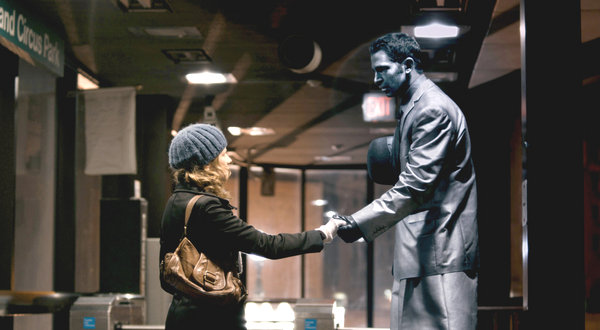
So I looked for something made very recently.  I wanted something contemporary and indie and real.  I found The Giant Mechanical Man.  I'd seen a trailer for it several months ago and remembered wanting to see it.  It stars Jenna Fischer (aka Pam from The Office) and Chris Messina (Danny from The Mindy Project or the husband in Julie and Julia) as two 20-30 somethings who are trying to figure their lives out.  Jenna plays Janice, who gets fired from her temp job, not for being unreliable, but simply for allowing her apathy for temp work to show.  Without a job she gets evicted and has to move in with her well-meaning but terribly insensitive sister who is constantly trying to "fix" her life for her.  To satisfy her sister, Janice takes a job selling concessions at the zoo (a job for which she is terribly overqualified, as the manager mentions when she hires her).  Tim is a street performer who dresses up as a giant mechanical man and wanders around the city.  He loves it, but when his girlfriend leaves him because she can't stand "the artist's struggle" any more, he decides he should try getting a "real" job, so he also gets a job at the zoo working sanitation.  The two quickly become friends.
I watched this movie first at work.  Then I came home and asked Matt if he would watch it with me.  I wanted to share it with someone.  He wrote his own review of the movie here, and I really like everything he said.  I sort of want to take up where he left off.  He talks about how this movie depicts real life in all of it's awkwardness.  People rarely talk to each other in perfectly turned phrases and bon mots.  They don't say the right thing.  Often a conversation is much more silence while two people try to think of something to say to the other that isn't completely stupid. This movie captures that in a really lovely way.  He also talks about how it is a movie about our generation and our problems.

This is what I wanted to talk about.  I have long been fascinated with the way movies reflect the cultural atmospheres in which they're made.  Where How to Lose a Guy reflected the optimism and the carefree feelings of pre-recession America, The Giant Mechanical Man reflects the bewilderment of my generation.  I don't have links to them right now, but I've read dozens of articles about my "lost" generation.  Articles about how people my age are waiting to get married, how we're losing the art of human interaction due to social media, how we aren't sure we are ready/able to be parents, and of course, how we are struggling to find something beyond "college work" that we could call a career.  We are supposed to be adults now, but we don't know how to do it and we're not sure we could even if we did know.  At one point Janice says "I feel like those people you were talking about, like I was just born into this life and I'm supposed to know what I'm doing.  Like I'm supposed to have it all figured out.  But I don't have it all figured out.  I just feel lost."  I feel like those words sum me up.  They sum up so many of my friends.  This movie is about feeling like everyone else somehow has it together, somehow has a plan, somehow knows the magical secret that you don't about how to be a successful human.  It's about wondering why you don't have that secret; what's wrong with you if you can't figure it out. But it is also about how to deal with that.

Tim invites Janice to go to a party with him.  It's a birthday party for some friend of his.  When it is time to blow out the candles on her cake, the friend stands up and gives a toast.  She thanks her friends and she thanks her man.  She says "It only takes just one person--just one person--to make you feel special, and valid, and like you belong in the world."  Later that night Tim is trying to explain to Janice why he likes her so much.  He tells her that she's real, and honest; he says "when I look at you...I can see you.  I can see you."
Yes, The Giant Mechanical Man is a love story.  But it's not a love story about two perky, adorable people saying perky, adorable things to each other and being oh so witty and oh so clever.  It's a love story for my time.  It's about two people who aren't sure what their life is supposed to be finding each other and telling each other that they understand.  Every time Tim and Janice talk Janice will try to explain her thoughts or her feelings to him.  She is not eloquent, she can't express herself clearly, but his response is always "I understand.  I get it."  She doesn't have to word it quite right because he's felt what she's trying to explain.  He knows it already.

There were so many other things that I loved about this movie.  I loved the colors.  I mean...I loved the colors.  They're rich and vivid and beautiful.  I think it is beautifully shot with some very interesting visuals.  I thought the music was fitting, it didn't feel overwhelming or blatantly manipulative.  So many things about this movie were perfect.  But the overwhelming feeling that is still lingering this morning--the thing that outshines all of the other wonderful aspects--was that this was a movie made for people like me.  It wasn't cloying or absurd or perky.  It was awkward in the realest sense.  It was sincere and unsure.  And it was honest.

Tuesday, July 24, 2012

More thoughts on Batman and morality and stuff...

When The Dark Knight came out, there were a lot of people who quietly said "hmmm...this movie is too much for me."  However, the overwhelming popular response to the film (of which I was very much a part) was one of unabashed adoration.  It's difficult to express your opposing opinion in the face of that much passion, I understand.  But with the Aurora shooting these people have, I think, felt empowered.  Here is a tangible (and horrible) act that validates how they've been feeling all along: movies about violence beget violence.  

I wrote a blog post a couple of days ago defending the Dark Knight as one of my favorite movies of all time. I tried to explain why I personally did not feel that it was too dark.  I should have made that statement more clear--I acknowledge that the movie absolutely has darkness, a great amount of it.  The point I was trying to make was not that the movie isn't dark, but that the darkness serves a purpose.  A purpose that, to me, is worthwhile.  

I have a couple of friends who have been very vocal about the reasons that they dislike these movies.  One friend, in particular, has shared with me a lot of quotes from LDS General Authorities about the need to keep the spirit present at all times, partaking of good things, and watching what we let into our lives.  If you are interested in reading these quotes, and they are certainly worth reading, you can see most of them here.  

However, as much as I have heard people speaking out against the Batman movies, I have heard just as many, if not more, very vocally opposing them.  Arguments that "guns don't kill people, people kill people" and "bad people will do bad things regardless of the media they watch and the laws we enact".  I had a conversation with a good friend of mine who pointed out that James Holmes was clearly insane and trying to argue that his behavior has anything to do with the behavior of a sane person is absurd.  People make their decisions and trying to control them with gun control laws and censorship is pointless.

I have generally been in the latter group.  My reasoning has been fairly simple.  I have watched the Batman movies, or even Taken, a film that I find much much more disturbing, and I have not taken my .22 rifle and shot anyone with it.  Nor have the majority of the thousands of other people who have also seen those movies, or movies infinitely worse.  The evidence of all the people out there watching movies and not shooting people suggests that violent films do not lead to violence.  

But...sometimes they do.  The fact is James Holmes was "inspired" by the Joker.  Now, you can say "Hey, he made a choice.  The movie didn't make him kill anyone, he chose to kill people."  Yes, technically that is true.  And frankly, I am as enthusiastically opposed to attempts at regulating people's lives as I can be about anything political.  I think trying to fix problems by passing laws is ineffectual and idiotic.  But I can't help but feel like American society has become addicted to ideas of individuality and independence to an unhealthy degree.  The cult of Live and Let Live has taken a choke-hold on our society, right down to the way we raise our children--"I just need to let little Sally and Johnny be who they are!"  Nevermind that who they are is a screaming hellion who will later grow up to make my life and many others miserable.  

Society is growing ever more isolated and we are losing our connections to our neighbors.  Partially this is because it is human nature to bristle against people "telling me what to do!"  But I think there is also another reason.  People don't want to feel responsible; they don't want to feel guilty.  If everyone can do what they want and no one is the boss of me then when something terrible like the Aurora shooting--or the Columbine shooting, or any one of the great host of horrible things that have been done in the history of the world--happens, I don't have to feel guilty.  I can feel sad for the victims, and I can feel horrified at the brutality, and I can feel angry at the perpetrator, but I don't ever have to feel responsible.  I don't ever have to feel as though such a thing, whatever the thing may be, was in any way my fault.  

How does a man become so delusional that he pretends to be the Joker and decides to kill innocent, random strangers without anyone noticing? 

Reality argues that no matter what we do there will always be crazy people doing crazy horrible things.  And honestly, I agree with my friend who said "I admit, I don't feel at all responsible for the Aurora shooting.  I didn't make him pick up a gun."  I don't think that the fact that I love The Dark Knight and the Dark Knight Rises means that it was my fault that a man 500 miles away from me lost the distinction between reality and fiction.  Nor do I think that the fact that I own a gun and would vote against gun regulation places blame on me for people I've never met deciding to kill.  

But maybe it should?

I don't know.  I really don't.  I wish I had some sort of conclusion to this post.  

But I wanted to write it to say that I understand.  I understand why my friends feel sick after watching movies full of violence.  I understand why the leaders of my church preach against violence and immorality and the desensitization such things can cause.  I agree with them.  I feel that society, as a whole, needs to realize that sometimes you DO have to take responsibility for the bad things that individuals do because, like it or not, human beings are social beings.  

As for my life, and the incongruities and contradictions that, perhaps, it exhibits, maybe I am wrong, or maybe I am living as best I can right now.  I don't know which of those is correct.  I know that I hate being told what to do just as much as anyone (possibly more than a lot).  I know that I truly do love the movies The Dark Knight and The Dark Knight Rises and see legitimate moral values in them.  I know that I'm trying to be a good person.  So...wherever that leaves us...is up to you I guess...

Sunday, July 22, 2012

Thoughts on Batman, Rising and Risen

Do you guys remember my SPATULA?  Well, first off, that died.  I didn't get the grant, so if I do end up doing that project it will be unfunded.  But the point of bringing it up is to use it as an example of how much I love the movie The Dark Knight.  That movie is, in my opinion, as pretty near perfect as a film can be.  I will go into why I feel that way a little later on, but you can imagine how excited I've been for The Dark Knight Rises with that sort of parentage, can't you?

I'm not the only one.  In fact, my excitement has been relatively tame compared to some I know.  I actively tried to avoid trailers and other promotional materials because in this case I didn't want to go into the movie already feeling like I knew what was going to happen.  And because I had this suspicion.  I was worried that this was going to be one of those movies where the hero gets pummeled beyond my idea of human endurance and I wouldn't want to watch it anymore.  And I didn't want to have to worry about that, so I just avoided watching the trailers.  Fun fact: it was not one of those movies.  In case you were worried like me.  

But anyway, I was super excited.  However, just as I was walking in to the theatre at 6:59 pm on Thursday evening I realized something.  There was no possible way that this movie was going to live up to my expectations!  That is, the chances were virtually zero.  I mean, Christopher Nolan is the guy who gave us Inception and The Dark Knight.  The expectations I had for him as a master storyteller were practically inhuman.  So, while it was possible that this film would be as good as I was hoping, I took a moment to prepare myself for it not to be.  Turns out this was a good thing.  

Now this is not to say that I didn't love The Dark Knight Rises.  First and foremost, please remember that, when I say that this movie did not live up to the one before it, that is comparing to an insanely high standard, and falling short of that standard still leaves the movie at a higher level than most others.  So please remember that, for the rest of this post.  Though I was disappointed (how could I not have been?) I still really liked the movie.  I would say it was as good as Inception...

I will put the rest of this post under a cut, so that you can avoid it if you've not yet seen the movie...

Friday, June 8, 2012

Little Miss Sunshine: Real Life Sucks

I've always been intrigued by Greg Kinnear's carier.  These are the Greg Kinnear movies I've seen:

Ghost Town
Little Miss Sunshine
Robots
Stuck On You
Someone Like You
Mystery Men
You've Got Mail
As Good As It Gets
Sabrina

Since I'm sure you didn't click on that link, I feel it important to let you know that those eight films come from a 49 title body of work that is really pretty impressive.  Which is to say that my impression of his career may not be at all accurate.  But the impression that I've gotten from Greg Kinnear is that, when he's not playing a little bit of a jerk: Sabrina, You've Got Mail, Ghost Town, Little Miss Sunshine, Someone Like You, Mystery Men, Robots...dang...I never realized how he's a bit of a jerk in, like, virtually ever movie I've ever seen him in...anyway, when he isn't playing that character he is playing really nice guys who gets a bit taken advantage of.  A little like James Marsden (I was so happy to see him finally get the girl in 27 Dresses...finally he got to play someone other than the nice guy who gets screwed!).
Look at him...bein' so nice!
His two personas overlap in the movie Little Miss Sunshine.  I just watched it again today.  I love that movie so much.  I mean...so much.  So much that I'm writing a blog post about it.  And why do I love it so much?  Because of the way Greg Kinnear's two personas overlap, and how that is representative of the entire film.  That is to say, I love Little Miss Sunshine because in that movie every single character's life goes completely to hell, and those series of events and the characters' reactions are so exquisitely true to life.

If you haven't seen the movie then I guess....spoilers?  It's not really a film you can spoil, but whatever.  I'll put a break and you can make your choices...

Thursday, April 26, 2012

The Descendants

Don't worry, I'll be writing up the rest of my Europe adventure soon.  But I wanted to write this up tonight while I was thinking about it...and it's sort of connected to my trip...

My flights to and from Europe were, as expected, exceedingly long.  I watched many movies.  The last movie I watched was The Descendants
In case you haven't heard of it, The Descendants is the movie that scooped up all the awards that were leftover after The Artist swept through (incidentally, I also watched The Artist on my flight and I highly recommend it--so awesome!).  Briefly, it is about a man who has to reevaluate his life when his wife is critically injured in a boating accident just when he is also facing a massive financial decision.  His relationship with his home, his heritage, and his two daughters are all examined.  That so doesn't do the movie justice, but it is enough to be going one with.

Now, as I say, this was the last movie I watched, and I didn't quite time it right.  I was about 15-20 minutes from the end of the movie when the plane started to land and they turned the movie off.  It was sort of in the midst of a major moment and I was like "WHA.....???!"  So last Thursday, when my good friend John asked me if I wanted to come over and watch The Descendants with him and Bryan I jumped at the chance.  Not only was I willing to watch the movie again when it wasn't on a wretched 4" LCD chair-screen, but I was dying to know how it ended.
One of the things I really loved about this movie was George Clooney's character, Matt King.  He is a good man who knows how and when to control himself--a trait I value incredibly highly.  When he finds out that his wife was cheating on him his first priority is to protect his daughters.  His eldest already knows, but his youngest, a challenging 10 year old, has no idea.  At one point his older daughter goes in to see her mother and starts shouting accusations at her.  He pulls her aside and pleads with her "Don't ruin your mother for Scotty!"  I loved that so much.  And I loved that only one time do you see him cave in and vent some of the massive anger you know he must be feeling.  For a brief moment he is alone with his wife and he breaks down shouting at her.  But very quickly he collects himself and you never see that anger expressed again.  Not even in the face of his father-in-law's cruel and unfair accusations.  I can't really explain how much this meant to me.  So often stories glamorize and advocate the lack of control as the only "real" way to experience emotions and I think this movie was a beautiful contrast.

But my favorite scene was the last one.  The scene I missed on my flight.  It isn't anything dramatic or exciting.  It's just one long straight shot, as though you're looking out of their living room TV right at their couch.  Scotty, the youngest, is tucked into a corner, wrapped in her mother's old blanket, and you see her father coming back from the kitchen with two bowls.  He sits down next to her and hands her one bowl, filled with strawberry ice cream, and pulls the blanket over himself as well while holding his bowl of mocha chip.  They sit there, eating their ice cream, watching a documentary narrated by Morgan Freeman, and you can see the elder daughter walk by in the background.  She pauses, then comes in to the room and perches on the edge of the couch next to her father.  He scoots over so she has room and pulls the blanket over her as well, while she sinks back into the couch against him.  After he settles the blanket over her, he hands her his bowl of ice cream and they all watch the TV.  He reaches over and takes a bite of strawberry ice cream, the camera watches them watching the show, and then the scene ends.

After the movie ended they asked me where exactly I'd gotten cut off the first time.  I told them and explained how sad that was because that last scene was my favorite in the whole movie.  Callie agreed, but then scoffed "Except...I'd love to see any family that actually does that.  Everyone sits on the same couch, under the same blanket, with only two bowls of ice cream?"

It was one of those moments where you feel yourself creating a future memory in your head.  The moment where something hits that perfect soft spot in your soul and you know that one day you will recreate that moment in your own life.  That's how I felt about that scene as I was watching it.  Then, when Callie scoffed at it I was sad, as though she was telling me that I couldn't create that in my own future family one day.  That beautiful moment of unity and comfort.

But I will create that.  I will have a moment under the same blanket, sharing ice cream, all on the same couch with my children.  And when that moment happens, I will look at my life from above for just one second and I will see that I have fulfilled my dream and my soul will be completely and utterly content for a heartbeat.

Thursday, January 5, 2012

Twilight: slasher fiction for the emotionally starved...

So my friend Danielle and I have this thing where we go and watch whatever Twilight movie happens to be out and we laugh hysterically.  It worked well for Twilight and New Moon.  She was out of the country for Eclipse so I missed that one, but I hear she went and saw it down in Brazil and laughed enough for both of us.  She has recently moved out to New York to be fabulous, but she's back in town for a few days visiting for Christmas so we figured we'd better get us to a late showing of Breaking Dawn 1.0
if your goal is mocking this seems promising, right?

What. The. Hell.

What the hell is that movie?  I'm sorry to be vulgar, but that is really all I can say, over and over.

So, for people like me who had no idea what was going on, here's a rundown.  I actually was just going through doing a play by play but it was taking way too long.  Especially when I realized that this movie is really just four things: wedding, honeymoon, express pregnancy, and delivery.  That's all you need to know.  They get married, they go on a honeymoon, she gets pregnant with the demon baby of death, and then she gives birth to said baby.  And somehow they stretch that into a movie just 3 minutes shy of 2 hours.

But that makes it sound sort of normal.  Oh no.  My first serious "this is wacked out!" alarm went off when she wakes up from her wedding night.  She's all gooey eyed remembering how beautiful it all was and then Edward walks in and asks her how bad she's hurt.  Then he pulls up her sleeves and you see his little fingerprints all over her arms and shoulders.   Suddenly you get a whole new perspective on abusive relationships as you listen to him abjectly apologize for hurting her, swear he never meant to and he'll never do it again, and listen to her get angry with him for...not for hurting her, but for refusing to hurt her even more.  What the what?  He sticks to it for a couple days and all the booty shorts and little negligees in the world won't sway him...until she wakes up from a dream crying cause he just doesn't want her...BLECH!

But that was nothing compared to Gollum!Bella of creeptastic pregnancy emaciation.  The emotional manipulation that happened between her and Jacob.  The bizarre militancy of Rosalee standing guard over PregnantGollum!Bella.  The sippy cup'o'blood to keep sweet li'l baby happy.  The abrupt change in Edward from baby loathing to baby worship.  All of it leading up to a scene that I don't think I'll ever be able to erase from my memory...the Vampire C-Section of Horror.  This is what happens, absolutely no exaggeration.  Bella, Edward, Alice, Rose, and Jacob are having tender bonding times when Bella drops her Cup'o'Blood as Edward hands it to her.  She dives after it and breaks her own back.  She falls, breaking her knees, and is about to splat her little head on the tiles till Edward dashes forward to catch her.  This sends her into labor, but Carlisle is out catching a bite, so it's up to Rose, Alice, Edward, and Jacob to deliver the little one.  Bella is lying there on the delivery table, back still broken, and the rest stand around at a loss till Edward says the baby is suffocating and Bella screams to get him out.  Jacob stands in as the husband, holding her hand and shouting at her to hang in there as Edward snatches up a scalpel and slices open her stomach.  Unfortunately, her uterus has become vampirized and scalpels are useless against it...so Edward rips it open with his teeth!  He comes up with his face covered in in his wife's blood and starts cooing over his new little girl!  Everyone just stands there!  No one thinks "Oh hey!  This woman has just had her stomach and uterus ripped open and may be hemorrhaging out, plus her back is broken.  This may be a good time to vampirize her completely...you know...while she's still alive."  Oh no.  No one even thinks "Oh hey, daddy might want to wipe some of the blood off his face."  They just stare at the baby, watch it take a bit out of it's mother, and coo over how cute it is.  Until Bella stops breathing that is.  Edward finally realizes his wife is in bad shape and hands the baby off to Rose.  He takes out a syringe of "vampire venom" and jams it into her heart.  When that doesn't appear to work he just starts sinking his teeth into her at random, a visual accompanied by a truly cringe-inducing squelching sound.  Nothing seems to be working, and he cries and Jacob cries and Bella looks like dead Gollum.  Oh.  But inside she's becoming a vampire and screaming her head off.  But you can't tell.  She just looks dead and sad.

I would post a picture...but you can't find any
 pictures of a scene that horrifying!  What does
that tell you?

You know what?  Forget the fact that Jacob then imprints on a baby girl.  Forget everything else about this movie--the bad acting, the horrible special effects, even the other questionable plot points.  What the HELL was that scene?  How do people go and watch that and still think that this is a great, beautiful, powerful love story?  What was that!?  I can't ask enough because I can't get an answer.  I walked out of the theatre so disturbed and so confused and so completely creeped out that all I could say was "why did we see that movie again?" over and over and over.

Friday, December 30, 2011

Chess, Mind games, and Infidelity

I'm in one of those hopelessly romantic moods lately.  They come upon me every now and then--wistful romantic yearnings for the passion that my life so distinctly lacks.  Silly moods.

So inspired, I was on the brink of watching Hugh Jackman in Someone Like You.  He has that great scene where he says everything you ever wished a guy would say to you while looking like...Hugh Jackman.  Plus he's delightfully cocky and annoying throughout the rest of the film.  But I decided to give Netflix one last try before committing... (though it has really disappointed me lately with its "Suggestions for you" ideas)

possibly the most adorable picture of
Hugh Jackman ever taken.  Possibly.
I already had Netflix open from where I was searching, quite fruitlessly, earlier today for something good to watch.  By pure luck, when I opened the tab, there was a movie I swear wasn't there before.  I'd never heard of it before, but it had Kevin Kline who I adore.  It was called Queen to Play, and appeared to be in French.  Kevin Kline speaking French?  I am intrigued...tell me more...
yet another entry into the grand tradition
of really wretched movie posters...
Brief synopsis: a French housewife (Helene) is living a drab life working two cleaning jobs, one at a hotel for a demanding boss, the other for a reclusive widowed professor (Kroger played, of course, by Kevin Kline).  She has an average husband (not amazing, but not a jerk) and a typical teenage daughter.  One day at the hotel she sees a couple on the balcony playing an impressively romantic game of chess.  She becomes intrigued with the game, quickly progressing into full on obsession after she buys an electronic set supposedly for her husband.  But the real turning point in her life is when she boldly asks the professor to teach her how to play.  The rest of the movie details the way her new-found passion changes her life.  Her relationships with her husband and daughter are effected, not to mention her job, and most of all, her relationship with herself.

Certainly the movie is crafted as one of those "self-discovery" movies where a repressed woman learns to love and believe in herself.  Sure.  It served that function perfectly satisfactorily.  This is my beef with those movies though; typically for the woman to "find" herself, she has to have some sort of affair with some random man.  What kind of self discovery is that?  The discovery that you lack integrity?  That is a shitty discovery (pardon my vulgarity, but it is the appropriate word) and if that was what you were out to discover, you should have stayed repressed.  Thus, I generally loathe those movies.  (This is where I go on a rant about the movies Serendipity and The Wedding Planner and any other movies based on the idea of infidelity and the fact that when you really really love someone it's ok to cheat on the person you're married to and also happen to only kind of love.  Hmph!)

Alas, this movie pretty much falls into the same family.

but...

About halfway through the movie I almost turned it off.  There was a definite sexual tension developing between Helene and Kroger.  Thus far Kroger has been a disinterested teacher, impressed against his will by her dedication and talent.  But one day they get caught up playing and discover that the day has passed them by and it is well past Helene's usual time of departure.  No big deal...except instead of going home Helene decides to stay and they have a drink.  They sit...they talk...they stop talking...and still she stays, just staring levelly at him.  Eventually you see him start getting ideas.  You really can't blame him.  She just keeps staring at him.  Just as he's about to say something, however, she gets up.  A moment later she is standing in front of a picture of his wife and he joins her.  He reaches up and touches a strand of hair and asks if she changed it.  Yes she has...and she'd better go home now.  Yes, yes she probably should...

That is usually the point where I start getting annoyed and turn the movie off.  I really don't tolerate unfaithfulness.  But I found myself in an interesting predicament.  Not only did I want to see how it all ended, but I really wasn't sure how it would.  So I kept watching.

Just so you know, the only person Helene has sex with during the movie is her husband (and lest you worry, you don't see much...the movie is rated PG).  That being said, I still would definitely say Helene cheats on her husband.  But I was fascinated with the nature of her infidelity--she has an affair of the mind, rather than one of the body.

The idea of cheating is definitely overt.  Her husband gets suspicious and follows her at one point, expecting to see her and Kroger in the midst of an embrace and is bewildered to see them sit down at the chess board.  He confronts her later and declares he'd almost rather she was having an affair.  It is clear that what is being seduced is not her flesh, but her mind.  The two of them, Kroger and Helene, are both excited by the stimulation the other gives to their mind.  Kroger several times refers to the rest of the world as idiots, pointedly excluding her from this condemnation.  Helene tries to share the game with her husband but he simply can't understand it, so as she says to Kroger, she doesn't know who else but him to play with.  And she must play.

This mental attraction is the temptation for Helene.  Her husband clearly offers her no such stimulation.  Thus, the sexual tension between her and Kroger really only serves to reinforce the connection which already has developed between their minds.  This is really brought home first in Helene's chess tournament.  Neither Kroger nor her husband come (her husband actually waits anxiously outside, terrified that she'll make a fool of herself or that his presence will "throw her off"), but it is Kroger she searches for, and then Kroger she sees in her mind's eye as she plays.  The viewer sees him at home, seemingly playing the game with her, and she sees him across the table from her giving her advice.  Truly, these two have become one.  She never even misses her husband.

In the end they do consummate their relationship.  But in following with it's very nature, it is not a physical union, but a mental one. Of course.  At the end of the movie she is at Kroger's house for the last time, telling him about her plans to go and compete at a tournament in Paris.  He is sitting in a chair and she is sitting on the arm.  Their talk turns to principles he's taught her, and then they play a "blind game", that is they play without a board or pieces, simply imagining the game and speaking their moves.  It was, without a doubt, one of the most intimate scenes I've ever seen in my life.  When the scene abruptly cuts to a shot of her kissing him and walking away, it seems natural that the sexual tension between them is now relaxed.  They've already come together, so their physical relationship, again secondary to the mental, would be much easier.
no pictures of their kiss, so I figured I'd go back to
Hugh Jackman...cause everyone likes seeing him kiss
As I said, I was fascinated with this depiction of infidelity.  Why?  Because it is a kind you rarely hear about but one which is just as dangerous.  And if, somehow, I were ever to be unfaithful, it would be like this.  The fact is, when you get married your spouse becomes your partner not just physically (and by that I mean with money, division of labor, and any other physical needs besides just sex), but mentally and emotionally as well.  Really, all of these different elements work together.  I was talking to a married friend the other day about the way physical intimacy reinforced her emotional intimacy with her husband in a way that conversation never could.  But it goes in reverse.  If all you have is a physical relationship and no emotional or mental investment then you will find yourself with no relationship at all.

Clearly, then, it is vital to remember that not only must you keep your physical lusts in check, but also your mental ones.  However.  Even more important, I would say, is this: every bit as appealing as sex is mental stimulation, possibly even more so.  Thus, it is far better, I think, to find someone with whom you can share that intellectual bond to begin with rather than fight the seduction of an extramarital bond with someone else afterward.

Really that is one of my greatest fear as I look for a husband.  I'm terrified that one day, five, ten, or twenty years from now, I'll realize that I'm terribly terribly bored.  In fact, I have to stop myself getting interested in guys who are clearly far more work than anyone should ever wish for themselves just because I think they have the potential to hold my attention long term as I try to deal with them.  That is not a healthy attitude and I'm trying to stop it.

And with that I shall leave you.  Again, I've not really come to any conclusions, just meandered about pondering aloud on things.  The joy of a blog I guess.  As for the movie, I must confess that upon infidelity though it was based, I somehow ended up liking it.  I would suggest it to anyone who enjoys foreign films.  If you are one of those people, go look it up on Netflix...

Friday, October 7, 2011

A shiny new SPATULA...

I have officially embarked on a new and exciting adventure known as "the Studious Project of Academic Ambition".  I will refer to it as SPATULA for short (SPATULA, as I'm sure you're aware, isn't actually an accurate acronym but I've always wanted to have a reason to use SPATULA as an acronym in my life and since this SPATULA is something I made up anyway I figure I can call it whatever I want).  The SPATULA is my first attempt at entering the world of grown up student-dom.  Cause real-life college students work on projects with professors to mentor them, and semi-important people to look at them after, or so I've heard, and I have made it through 5 years of college without ever doing such a thing.  I haven't ever even applied for an internship, let alone been accepted and done an internship.

So what the SPATULA actually is an ORCA project.  I have no idea what ORCA stands for, aside from a smallish black and white whale.  But what it means is money to do something you want to do.  Yeah.  An ORCA project is where a student goes to a professor that she likes and says "hey, so I've always wanted to write this ridiculously massive blog post that no one would ever take the time to read about comic book movies and Jane Austen characters and cartoon anti-heroes and how they are all examples of the conflict between duty and inclination in the heroic figure.  But since nobody would read that as a blog post I thought maybe I should turn it into an official research paper instead.  Do you want to help me with that?" and he says "That sounds like a great idea!  Let's do it!" and then we sit in his office and talk a little bit more about my idea and he says "You have a lot of really good ideas here, but there are about 5,000 of them and you should probably limit them down to 1, or 5 at most so why don't you go home and try to do that."

So you go home and spend a week trying to figure out how to pick one idea out of all those ideas that is your favorite.  And after a week of thinking you go back to talk to your professor and the only progress you've made is actually the exact opposite of progress in that you've actually thought of more ideas instead of weeding some out.  So you tell your professor all the ideas you've added, and you talk for a little while and then somehow magically during your conversation you realize that you actually have found that one unified idea you want to discuss.  So then you go back home and for another week you research whether or not anyone has already written the paper that you want to write.  If they haven't, congratulations you get to tread brand new pointless academic soil.  If they have, well, rethink your idea or do it again but better.  Then, after you've done that research you take that beautiful nugget of an idea and write up a proposal that sounds really awesome.  You mention how your idea is so fabulous that you actually need two professors to mentor you.  And you really really want to write this paper.  So much that you're volunteering to write a completely superfluous research paper in the midst of your semester of required papers and other homeworks.  And then you take that proposal to a bunch of professors and try to inspire their enthusiasm with yours so that they say "Oh my gosh, we think that is a truly fantastic idea!  So fantastic do we find this idea that we want to give you some moneys to put take this idea and write that research paper.  Here, take this $1500 dollars that we have lying around and go and write your paper!"

And after they give you your $1500 dollars you...go and do your project.  You do real research and really start digging into your ideas and write the research paper you've been wanting to write.  I don't actually know how long you have to do this project, nor do I know how particular they are in the way you use your newly acquired funds in the pursuit of the final product.  These are mysteries, however, that I assume I will penetrate very soon.  Because I have officially embarked on my SPATULA.  I have completed the first half of that paragraph up there.  I've spoken to my professor and we've discussed my idea.  And as of today, we somehow managed to find that core idea at the heart of it all that I really wanted to focus on.  Are you ready for this?  The core idea of my SPATULA will be the following:

Utilizing the exaggerated nature of the comic book superhero persona I will examine the definition of Heroism and the conflict between the heroic persona and the individual will.  

Pretty cool, eh?  Can you believe that I construct sentences like that for fun? 

I'm going to be focusing on three main references for my project.  Superman, Batman, and V (from V for Vendetta).  I think that they represent three clear points on the spectrum of the hero.  But that is all I'll say about them lest I start boring you all with the subject that was too boring to be a blog post (see, it was too boring to be a blog post, but writing about how it was too boring to be a blog post was not...huh).  

And that, my friends, is my SPATULA (do you all still remember that SPATULA actually stands for Scholastic Project of Academic Ambition?).  Sitting here on my bead trying to think of something to do on yet another plan-less Friday night, the best possible idea I could come up with was to write a blog post about it.  Having done so, I shall endeavor to keep the world apprised of my progress.  It's possible this will be an extremely short saga, if I either don't get my proposal completed by October 28 (the proposal deadline) or I do but the board decides that it isn't worth funding.  Although, even if they don't, it isn't like this is a project that really requires all that much money.  I could just continue on with it even if they don't approve it.  I think that I shall.  This idea has actually been fermenting in my brain for about three years and I figure, if it has that kind of staying power, then it deserves to finally come to maturation.  

So, my friends, here I shall leave you.  Here on the very brink of a SPATULA, as I endeavor to take my adolescent existence and force it into an adult one.  We'll see how this works out...

Tuesday, June 21, 2011

The Dangers of Over-Attachment and Other Lessons Learned Through Obsessive TV Binges

On the off chance that there is anyone on earth who reads this blog of mine and somehow hasn't seen Buffy the Vampire Slayer, Firefly, or Doctor Who, I must warn you that a.) there be massive spoilers ahead and b.) you may have no idea what is going on for a while...I'm sorry.

I went to a dance on Friday and I met a very nice guy who, in the course of our dance, asked me "Do you keep a blog?  If you go home and write about the dance tonight on your blog, what are you going to write?"  This question made me smile.  While I do write nauseatingly detailed accounts of the dances I attend, as well as every other possible event (or non-event) in my life, the fact is that I save that sort of thing for the private blog I think of as my journal.  Here on my public blog I write dry, uninteresting, philosophical flights of whimsy.  I suppose, ultimately, that neither of those two options are particularly ideal for a public blog, now I think about it.  And yet, here I am, about to embark on just such a flight as I ponder the human appetite for melancholy and tragedy.

The problem is that it is late and I've been watching Buffy the Vampire Slayer.
Yeah.  That.  

See, here's the thing.  I have this problem where, when I get sucked into a TV show, I get far too attached to the characters.  Another good example of this would be the Doctor and Rose:
This is what happens.  I start watching a show.  Maybe, like with Doctor Who, I fall utterly in love with it.  Maybe, like with Buffy, I am only half-heartedly interested.  But in both cases there is one or two characters that I get attached too.  Very attached.  And then heartless, evil writers take that character (Angel, Rose) and brutally tear them from the show and my soul.
Sure, in the case of Buffy, Angel comes back.  But I'll tell you what doesn't happen to Angel.  He doesn't ever get to live happily ever after with the girl.  And Rose?  Sure, she might have 10.5, but no matter what you tell me, he isn't the original, and she's stuck in a bloody alternate reality.  And even if she has 10.5, 10 doesn't have her.  So it's still a wash.

I was crushed after I watched the season 2 finale of Doctor Who.  I am absolutely not kidding.  For two weeks I walked around thinking about Rose and the Doctor almost constantly and felt depressed and despondent.  That was a few years ago.  Then, two nights ago I watched Angel lose his soul and break Buffy's heart, and I thought that was the worst Whedon could dish out to me.  Then tonight I watched him regain it back, just in time for Buffy to realize she had her Angel back...and then stab him to death.

Here's the thing--I hate Joss Whedon.  And Russell T. Davies too.  I hate these men.  I hate them for writing these characters, these two people who share a passionate, soul-mate-esque connection, and then writing them be brutally rent apart.  I'm not exaggerating.  I feel the sort of anger, bitterness, and resentment that should be reserved for cheating ex-fiances or beloved athletes who are caught using performance enhancers.  Extreme?  Maybe.  But you read the bit about me getting obsessively over-attached to these characters, right?

It was just tonight that I watched Angel die.  I fired off an irate text to a friend cursing the heavens and Joss Whedon for the cruelty of it all.  She texted me back, sympathetic, but insisting that I couldn't really hate Joss Whedon and his genius.  Oh but I can...
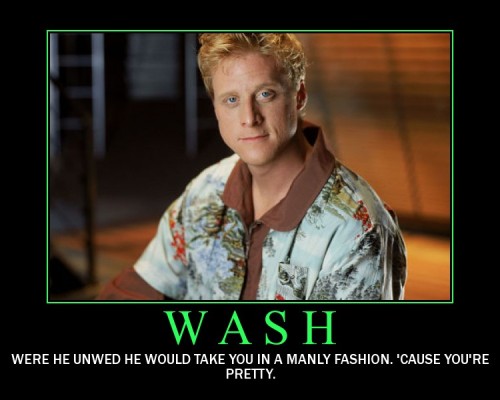
But I did have to stop and think.  Because I really did love Wash, but when he died I didn't hate Joss Whedon like I do now.  And Wash was actually the dead sort of dead that stays dead and doesn't come back next season and get his own hit spin-off.  Not to mention, I didn't hate Baz Luhrmann when Satine died in Christian's arms.  I didn't hate the writers of V for Vendetta when V died in Evie's arms.  Or any of the other people responsible for all of the other tragic stories I've watched, heard, and read through my life.  On the contrary, I've always had a strange love of melancholy.  Really, I've always preferred stories flavored with tragedy rather than comedy.

This is not unique to me.  The beauty of sadness is a western tradition.  From Oedipus Rex to Romeo and Juliet, to Titanic, western society has always had an obsession with pain and suffering and love being lost.
Interestingly, this is something rather unique to Western culture.  In traditional Chinese and Japanese stories the endings are almost exclusively happy.  Certainly there are terrible things that the hero or heroine go through, but in the end they triumph; they don't die, or go mad, or lose the most important thing in their life.  This begs the question, is our cultural obsession with tragedy something we've somehow learned/conditioned within society or is it actually part of the human condition itself?  After all, with the westernization of their society, tragedy is starting to creep into the stories being told in East (at least, that is what I've been told by people who would know).  Are we all, then, obsessed with tragedy?

What is it exactly that draws us to sad things?  In ancient Greece the first drama was tragic.  To be precise, Greek drama was born as a vehicle to achieve catharsis.  They would put on productions of these tragic plays, Oedipus, Antigone, or Achilles, where the protagonist was always subject to one tragic flaw.  No matter how noble he (or she) was, this tragic flaw would doom him to destruction.  He couldn't escape his fate and he would die, often in horrible circumstances.  The audience would watch his destruction; they would pity him and be horrified by the depth of his fall.  That was the catharsis.  The entire purpose of the play was to inspire those emotions of pity and horror in the audience, and thereby purge them, if only for a time.
I could believe that the draw of tragedy is the cathartic experience.  It is the vicarious experience of some of the most intense emotions human beings are capable of; still real, yet removed to a safe distance.  It wasn't actually your lover who was killed, but you watched her lover get killed and you imagined you were her, how you would feel, and you wept.  Except...why would you want to experience that?  Why would you seek it out?

I don't think it is simply the experience of the emotions; it is that there seems to be something beautiful in them, in the feeling of them.  We seek out these opportunities to feel the most painful emotions we posses because there appears to be some intrinsic worth in doing so.  What is it?  Think of that scene in Stranger Than Fiction, when  Doctor Hilbert has read Harold's death and he tells him he has to die.  Unfortunately, I can't find the exact quote right now, but he says something along the lines of "Everyone dies eventually Harold.  A heart attack in your bathtub in twenty years, you choke on a piece of chicken tomorrow, everyone dies.  But I guarantee, however you go, it won't be as poetic, as beautiful, or as full of meaning as what she has written for you."  While Dustin Hoffman has some insensitive moments written for laughs, this is not one of them.  Nor do we write it off as a skewed opinion from an out-of-touch professor as we do some of his other callous lines.  When Dr. Hilbert says it we mourn for Harold and his newly discovered life but we accept it.

The thing is, all people suffer.  But some people suffer with dignity and others suffer without.  Suffering without it is something to which we are all susceptible, and which we all fear.  People who cannot endure are succumbing to a weakness we all could possess.  I think that is what draws us to tragedy and that is where the cathartic experience comes in; we can't condemn the people who cannot rise to the challenge because we might not either.  But the stories of triumph are an inspiration.  They offer us a hope of what we might be. Suffering with dignity requires depth of character and maturity of mind.  People who endure something tragic are exemplifying the best of human abilities.  The beauty of sadness is in the exchange between what is and what could have been.  Pain brings out the best and worst of a person.  It is poignant and melancholy and beautiful to see failure and imagine the success that could have been.  It is inspiring, uplifting, and excruciating to see a strong bright soul punished over and over and refuse to break.  We watch and film and write and read and hear and tell these stories over and over again to see what humans are capable of.  What we think they're capable of, and what we think they aren't.  We explore the consequences at the boundaries of the human spirit and search for inspiration and consolation.

Which, I guess, leaves us at a good place to come back to where I started all of this.  My heartbreak over two fictional characters from TV shows.  I'd be hard pressed to come up with any real distinction between Rose and Angel and the rest of the tragic pantheon.  I can't rationally prove why the ending of their stories made me literally, actively angry at their writers, where other tragic stories convert me to near worship of the genius of their creators.  No rational reason.  But irrationally...I love them.  For some reason I identify and connect with their stories.  Embarrassing as it is to admit, you could easily make the argument that I no longer experience their tragedies as external performance events I sympathize with, but rather as personal losses of my own.  It isn't just the Doctor losing Rose, I lost her too.  Not only Buffy was powerless to save Angel, so was I.  And then the show goes on.  The Doctor flies away to find a new companion.  Buffy goes on to find a new vampiric lover.  Life, essentially, goes on.  Next week, same time same channel, the story continues with new characters.  In the fictional world of the story the Doctor or Buffy might have had time to mourn, but I didn't.  And if I am this crushed over fictional characters, then what hope is there for me in the real world with real loss?  Perhaps this is the root of my anger at Whedon and Davies.  They force me to admit that I may not be quite as strong as I would like to think I am.

I guess this means I've not yet experienced enough catharsis...