Pages

Saturday, January 26, 2013

Yesterday I fell in love...

Yesterday morning I watched How to Lose a Guy in 10 Days.  Incidentally one of the last tolerable Matthew McConaughey films ever made, unless you count Magic Mike, in which he simply plays himself.  In this movie you have savvy, cute, intelligent Andie Anderson (played by the queen of the decade Kate Hudson), a writer for the fastest growing women's magazine who wishes she could stop writing silly How To articles about getting skinny and avoiding tickets and could instead write something called "How to Bring Peace to Tajikistan".  Cause, you know, she's super smart!  And you have Ben Barry, an advertising agent trying to snatch a big diamonds account from two super slutty coworkers.  Andie tells her boss that her next article will be "How to Lose a Guy in 10 Days" where she'll start dating a guy and then drive him away using all the usual mistakes that most women make.  Ben makes a bet that he can make any woman fall in love with him in 10 days, and if he wins he'll get the big account.  The evil slutty coworkers pick Andie, who happens to be at the same "top watering hole for the young upwardly mobile", to be the lucky girl.  The rest of the movie is Andie bouncing between being her charming and delightful self and an insane, clingy, devil-spawn and Ben trying desperately to not shoot himself in the face as he tries to deal with her and also make her fall in love with him.  Hilarity ensues.

I still enjoy this movie on a very superficial level.  It's mildly funny to see all the things Andie does to drive Ben crazy.  But the entire time I am just thinking "this is absurd!  What is wrong with these people that they're actually doing this?  What is wrong with them???!!"  Why would you screw with someone like that?    And then why would you keep screwing with them when you started to actually like them as a person?  Not only that, but here are two young adults in very promising careers who have so few problems that the only way to create enough tension for a movie is to manufacture the world's stupidest work....assignments? bets? whatever... This is not my life.  I don't know whose life they're supposed to be portraying, but it is no one I know.  The whole thing left me with a distinct disgruntledness.  Who are the people that are supposed to identify with that movie?  This movie was made before my generation had quite grown up and faced reality.  It was made in a different time, in a different social atmosphere and it is no longer relevant to the world in which I live.

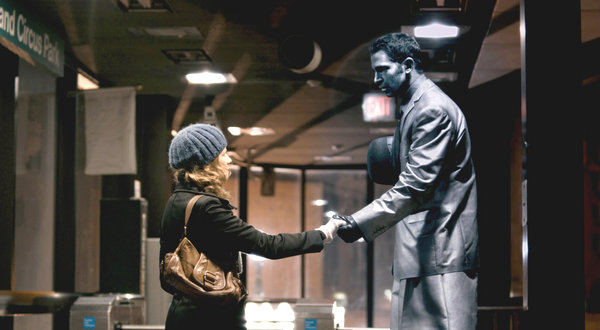
So I looked for something made very recently.  I wanted something contemporary and indie and real.  I found The Giant Mechanical Man.  I'd seen a trailer for it several months ago and remembered wanting to see it.  It stars Jenna Fischer (aka Pam from The Office) and Chris Messina (Danny from The Mindy Project or the husband in Julie and Julia) as two 20-30 somethings who are trying to figure their lives out.  Jenna plays Janice, who gets fired from her temp job, not for being unreliable, but simply for allowing her apathy for temp work to show.  Without a job she gets evicted and has to move in with her well-meaning but terribly insensitive sister who is constantly trying to "fix" her life for her.  To satisfy her sister, Janice takes a job selling concessions at the zoo (a job for which she is terribly overqualified, as the manager mentions when she hires her).  Tim is a street performer who dresses up as a giant mechanical man and wanders around the city.  He loves it, but when his girlfriend leaves him because she can't stand "the artist's struggle" any more, he decides he should try getting a "real" job, so he also gets a job at the zoo working sanitation.  The two quickly become friends.
I watched this movie first at work.  Then I came home and asked Matt if he would watch it with me.  I wanted to share it with someone.  He wrote his own review of the movie here, and I really like everything he said.  I sort of want to take up where he left off.  He talks about how this movie depicts real life in all of it's awkwardness.  People rarely talk to each other in perfectly turned phrases and bon mots.  They don't say the right thing.  Often a conversation is much more silence while two people try to think of something to say to the other that isn't completely stupid. This movie captures that in a really lovely way.  He also talks about how it is a movie about our generation and our problems.

This is what I wanted to talk about.  I have long been fascinated with the way movies reflect the cultural atmospheres in which they're made.  Where How to Lose a Guy reflected the optimism and the carefree feelings of pre-recession America, The Giant Mechanical Man reflects the bewilderment of my generation.  I don't have links to them right now, but I've read dozens of articles about my "lost" generation.  Articles about how people my age are waiting to get married, how we're losing the art of human interaction due to social media, how we aren't sure we are ready/able to be parents, and of course, how we are struggling to find something beyond "college work" that we could call a career.  We are supposed to be adults now, but we don't know how to do it and we're not sure we could even if we did know.  At one point Janice says "I feel like those people you were talking about, like I was just born into this life and I'm supposed to know what I'm doing.  Like I'm supposed to have it all figured out.  But I don't have it all figured out.  I just feel lost."  I feel like those words sum me up.  They sum up so many of my friends.  This movie is about feeling like everyone else somehow has it together, somehow has a plan, somehow knows the magical secret that you don't about how to be a successful human.  It's about wondering why you don't have that secret; what's wrong with you if you can't figure it out. But it is also about how to deal with that.

Tim invites Janice to go to a party with him.  It's a birthday party for some friend of his.  When it is time to blow out the candles on her cake, the friend stands up and gives a toast.  She thanks her friends and she thanks her man.  She says "It only takes just one person--just one person--to make you feel special, and valid, and like you belong in the world."  Later that night Tim is trying to explain to Janice why he likes her so much.  He tells her that she's real, and honest; he says "when I look at you...I can see you.  I can see you."
Yes, The Giant Mechanical Man is a love story.  But it's not a love story about two perky, adorable people saying perky, adorable things to each other and being oh so witty and oh so clever.  It's a love story for my time.  It's about two people who aren't sure what their life is supposed to be finding each other and telling each other that they understand.  Every time Tim and Janice talk Janice will try to explain her thoughts or her feelings to him.  She is not eloquent, she can't express herself clearly, but his response is always "I understand.  I get it."  She doesn't have to word it quite right because he's felt what she's trying to explain.  He knows it already.

There were so many other things that I loved about this movie.  I loved the colors.  I mean...I loved the colors.  They're rich and vivid and beautiful.  I think it is beautifully shot with some very interesting visuals.  I thought the music was fitting, it didn't feel overwhelming or blatantly manipulative.  So many things about this movie were perfect.  But the overwhelming feeling that is still lingering this morning--the thing that outshines all of the other wonderful aspects--was that this was a movie made for people like me.  It wasn't cloying or absurd or perky.  It was awkward in the realest sense.  It was sincere and unsure.  And it was honest.

Wednesday, January 23, 2013

Personal Progress...

I'm not gonna lie.  I kind of hated personal progress when I was a teenager.  It didn't seem important to me, the projects seemed like busy work, New Beginnings was an annoyance.  And yet, here I am at 26 struggling to take control of my life.....I'm trying to institute my own version of personal progress.  Howe humiliating.

I wrote a post a couple of weeks ago about a better way to motivate myself to improve the things that need improving.  I said at the time that it was likely to be the first in a series of, um, (for lack of a better/less cliche phrase) self-makeover posts.  At the time I was thinking my next post would be a continuation of the "I'm great right here, right now" theme.  However, the project I was thinking about at the time isn't happening just now (don't worry, I'll talk about it later).  Instead, I've been thinking today about the "where I want to be" side of things.

Last night I did 10 sit ups.  Just 10.  And then I stopped.  And I am not joking when I tell you that my abs didn't even wait till morning to let me know that they were not excited about that idea even a little bit.
this is how my guts felt.
I texted Kara after I finished: "I just did 10 sit ups and then stopped.  Clearly I am not good at exercise."  She texted back enthusiastically "that's excellent!"  Bless her heart.

But here's the thing.  Between none sit ups and 10 sit ups.......10 sit ups is excellent, if only because it isn't none.  Because even if I only did 10 yesterday, maybe today I'll do 15.  Or maybe I'll just do 11?  But the point is that I'm doing something, and if I start small, well then there's plenty of room for improvement.
the one place we all know will always have room for improvement
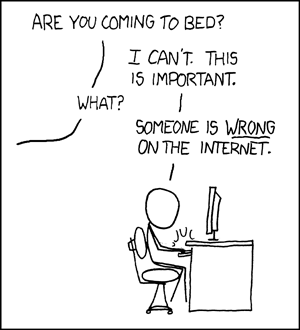
also, this is from xkcd.com, in case you live under a rock...
Part of the reason that I never work out is because I think about the prospect and I think about how much work it's going to be and it literally drains me of every ounce of....of anything!  Of desire and energy and good intentions.  (at this point I would like to post the clip of Jim Gaffigan talking about going to the gym, but alas it does not appear to exist on youtube.  so instead I'll tell you to go to netflix and watch both of his specials because they're ridiculously funny, and pay special attention to the part about the gym).  Anyway, I think this is because I assume that if I work out it is going to have to be super maximum hardcore and intense and I'll have to spend so much time on it and it will make me want to kill myself.  As I explained to Kara, the evening we spent making and gorging on poorly executed yet nonetheless delicious and fattening candy, I have never yet experienced the so-called "runner's high".  That is to say--I don't appear to have a body that releases endorphins when I work out.  I get exactly nothing from the experience except exhaustion and misery.  I'm not hyperbolizing for rhetorical effect.  I feel like shit after I exercise, and all I want to do is die.
ah grumpy cat...you never fail me
But I realized last night that when you're as out of shape as I am.....well, maybe starting with 10 sit ups is a perfectly good idea.  In my defense, I want you all to imagine not just that you're doing normal sit-ups, but that you're doing them with a 10 to 15 pound weight sitting on your chest.  Not to mention, you have the abdominal muscles of a 3 year old with stomach flu.  But the point is that I realized that...I could stop at 10.  It was something, but I didn't have to keep going till I hated life and wanted someone to punch me in the face to distract me from how much I hated it.  And more importantly, I stopped before I became overwhelmed at the impossibility of doing this insanity to myself more than one random night in my life.

And one last thing....even if I don't do 10 sit ups tonight, or 15, or 11, or whatever...I will do them tomorrow and that's ok.  Or if I do them tonight, but not tomorrow, that's ok too.  If you fail on any given day all it means is...well, nothing.  Tomorrow is, as Scarlet O'Hara says, another day upon which any previous days have no bearing.  I won't get overwhelmed and I won't get discouraged.  It's funny how cliches are cliche for a reason.

Monday, January 7, 2013

Sometimes a little self-love is not a bad thing...

One of the key aspects of Mormonism (and probably most other religions, but I don't have firsthand knowledge) is the idea of repetition.  That is--you can never hear those "plain and simple truths" too many times, you can never read the scriptures too often, you can never study the gospel so much that you no longer have anything to gain from it.  Endless relief society lessons on visiting teaching and motherhood aside, I have found this idea to be, more or less, true.  Not simply at church, either, but in many other facets of life.  In fact, there is one particular idea that comes to me, epiphany-like, every couple of years.  It's like seeing fireworks; even though you've seen them before and, really, one firework is pretty much exactly the same as the next firework, every time you see them again it's like the first time.  They're beautiful and thrilling and dazzling no matter how many times you see them.  That's like this idea of mine.  Every time it bursts inside my head it is illuminating and inspiring like the first time I ever thought of it.  Even though it's clichéd and recycled.  It is simply this:

The most effective changes in your life come from self-love, not self-hate.  

So many times I have taken stock of my life and and I have looked on the results with loathing.  I have been so disappointed in myself.  I've seen my failings and my faults and I have asked myself why I have not yet fixed them.  I can't understand it.  I know what is wrong, I know what needs to be done to fix it, and yet the problems remain.  How pathetic must I be that I can't just fix the damn things already?  Over and over again I come to the same conclusion:  I must not hate my problems--my sins--enough to excise them from my life.  I must secretly like all these faults.  I must not want it badly enough...

 I must not be unhappy enough.

That's consistently where my thoughts end up.  So many times.  So I just hate myself a little more.  And it's a beautiful system, really, because it's so self-sustaining.  Now, not only can I hate myself for my imperfections, but I can also hate myself for, apparently, deep down not hating them and for lacking the discipline to change all these things I hate, which means that I can hate myself for choosing to be miserable....you can see it just keeps going...

But amidst all that disappointment and dislike, do you know what doesn't happen?  Any of those changes I wanted way back in the beginning.  I get so distracted and weighed down with hating myself that either I don't have the time or attention for actually fixing the problems, or I simply give up and accept that it's not worth the effort for someone as pathetic as me (and even if it was, it wouldn't work anyway).  You can see the problem here, I think.

Do you know when I have had success changing myself and my life?  Clearly it is not when I am depressed and full of self-loathing.  The times when I have had the most success effecting the changes I want to see in my life are the times when I love myself, and am proud of myself, and tell myself that I'm doing ok.  

The way it works in my head is that the more I hate myself, the less I am worth the effort of trying to improve--why suffer through all the work I know it will take for something I actually dislike?  But the happier I am with the current me right here and right now, the greater the value in investing in this self.  If that makes sense...

Which finally leads us to the here and now.  I honestly have no idea why it is happening, but I find myself in a place where I am consciously trying to cultivate that positive attitude about myself .  Usually this sort of positivity requires the kick-start of an extended and extreme happiness.  But I can't really say I've been extremely happy all that much recently.  Regardless, I have started trying to invest in myself.  Those initially minute investments have been enough--not enough to inspire greater investment, but enough to remind me of that ever-recurring epiphany.  Enough to inspire me to start loving myself so that I will then want to continue investing even more in myself.  

There is a lot more I want to write on this theme.  There are some specific experiences and challenges that are looming on the horizon that I want to discuss.  But in the interest of length (this is already too long) and time (it's my bedtime now...) I shall leave those for another post.  This is enough to be going on with for the time being...

Friday, December 28, 2012

To my brilliant, beloved, and wonderful grandmother...

I went home for Christmas and was lucky enough to see my grandmother right before she drifted off into the sleep with which she will end her life.  I spoke to my mom this afternoon and she confirmed that grandma hasn't woken up and will likely die within days.  I can't begin to explain how I felt the first time I saw her there at Wildflower, the home we've had to put her in.  This is a woman who I have looked up to my entire life and she was diminished to a skeletal creature in a wheelchair.  I couldn't stop crying that first visit.  It got better the next day, and the next, but only because I was able to disassociate and disconnect.  The woman in that chair was not the grandmother in my memory.  They were two different people.  

But finding out that she is leaving for good, that the end is here (mercifully sooner than anyone expected) is not as easy as I thought it would be.  Certainly I am glad that she (and my mother, who has born the entire weight of her care as well as my grandfather's) will be spared the years of senility that her own mother suffered.  But that doesn't change the fact that my grandma is dying.  She's going to be gone forever.  And in the end I find that I'm just a little girl who misses her grama and doesn't want her to leave and can't understand that it's better this way.  

I wanted to write something here to commemorate her.  Something that would represent what she was in my life.  But I couldn't think of anything better than the final that I wrote for my English Literature class on my study abroad in 2007.  With some minor alterations and additions, here it is
            The assignment was to write an essay that related the class readings to the places they’d visited.  My fingers hovered above the keys expectantly—waiting for inspiration to strike.  All that struck was a hand on my bedroom door, giving me a distraction from my un-inspired thoughts.  The harder I tried to focus the more my mind wandered.  I asked myself how ideas might relate to places…
            I’d heard of memories being related to smells, and smells could be related to places.  For instance, I remember very distinctly the smell of my grandmother’s food-room back in New Mexico.  It was a cold smell and somehow pleasantly musty.  Like the smell of damp earth, even though the room was above ground.  Whenever I smell that smell I remember the room, cool and dark, even when the light was on.  It was one of my favorite places at my grandmother’s house, especially when it was my grandmother who took me there.  And because I loved my grandmother’s food room, I loved the food-room in my aunt’s house, and then finally the one in my mom’s new house. 
            The connection, then, was food-rooms to the idea of my grandmother, I supposed.  But really, that was not an example of an idea being connected with a place, except in barest technicality.  In actuality it was simply a fragment of my definition of my grandmother.  It was part of what made my grandmother in my mind.  She was many places and things and actions and ideas. 
I considered the idea of my grandmother and saw a kaleidoscope of things:  My grandmother teaching my addition; admonishing me to “burn the sums into my brain”.  My grandmother giving me raisins out of a Tupperware pitcher with a yellow lid as I sat on the wooden stool in the corner of the kitchen.  My grandmother bringing me a golf ball-sized blob of peanut butter cookie dough as I played in my uncle’s room on the green fuzzy carpet.  Then, more, after they all moved to Oregon.  I saw my grandmother’s small brown dish, or the blue plastic one, with two small scoops of Tin Roof Sundae ice cream in it and her sneakiest smile that told me this was a treat just for us.  I heard my grandmother teaching me and my brother one single phrase of Latin to say to the kids at school when they were mean.  There was my grandma sitting with my mother and uncle, singing “Dooley”.  Overarching them all were the bookshelves full of carefully organized and jealously guarded books.  Endless shelves hiding tempting treasures.  Sherlock Holmes and Freckles and Wind in the Willows.  That part of my grandmother that was a passionate love of books was also a part of me.
            I thought about these aspects of my grandmother.  I thought about the things that I refused to accept as part of her.  Those first years when the most articulate woman I knew started forgetting words; joking in the yellow light of our kitchen about the time when all it would take to entertain her would be the magnets on the fridge.  We’d cackled all the more at the looks of others who couldn't understand our morbid sense of humor, that it was better to laugh than cry.  Then the breathtakingly quick crescendo from a disoriented woman who wandered ceaselessly around her house and still harmonized at the family singalongs even if she couldn't remember the words…to a stranger huddled in a wheelchair in an unfamiliar room in an unfamiliar building, mumbling indistinctly from lips that were no longer quite under her control.    
None of these memories were places, though places were a part of the memories.  Yes, there were places in my mind, but to limit my grandmother to one place was like limiting the ocean to one grain of sand on one beach.  Would that be the same for anything? 
I remembered when we read “A Room of One’s Own” in class; how, before I even began to read, my mind resolved to like the story, based only on the fact that, long ago, my grandmother told me that someday I needed to read it.  Now I had read it, and liked it very much.  I thought it was brilliant, in fact.  But the only thing I could remember distinctly was that the book was everlastingly bound to my grandmother.  So, it seemed that a book could be connected to one single thing; perhaps if that single thing contained many things within it.  Perhaps it was only because it was my grandmother to which it was connected, and my grandmother contained all of me.
My mind floated back to the beginning.  There were my fingers, still expectant.  There was the screen, still blank.  Another hand was knocking at my door.  I smiled at the thought of my grandmother and began to type.

Thursday, December 6, 2012

Sometimes you just need a little perspective...

Cliche as that is.

It's been another one of those days weeks months.  The ones where most nights the only way to stop your panic attack is to force yourself to fall asleep.  Where you have a constant headache because all your anxiety manifests itself in relentless tension in your shoulders and neck.

Where the careful balance of your life, perpetually held on the edge of the abyss, finally seems to be tipping past the event horizon of your control into full chaos.

When I first started dancing I remember a conversation I had with Chelsea.  I told her that sometimes when I'm dancing it's like my body gets over excited and rejects my supervision.  My spins start going crazy, my feet start flying all over the place, and I simply cannot keep my balance.  It's like I'm trying to go everywhere at once, and so, of course, I maladroitly go nowhere at all.  Chelsea advised me that the next time I noticed this happening I should stop dancing for just a moment and recenter myself.  Pull myself inward, either mentally or literally, and focus on my core.  Be still a moment.  Off the top of my head, I would be willing to claim that as the most helpful advice I ever received about dancing.  It certainly has stuck with me and proved its usefulness and truth repeatedly.

But tonight I realized that it is not just good dancing advice.

Today, even if just for this evening, I was able apply Chelsea's dancing advice to my life.  I was able to stop for a moment and recenter myself.  I was able to pull myself in and focus on my core.  I was able to be still.  It began with one of the most considerate and generous things anyone has ever done for me (the beauty of perspective is how something can be just a simple "nice thing" to one person, and yet mean the whole world to another).  I think one of the greatest things you can ever do for someone is find a way to make them feel sincerely and deeply cared about; that is what was done for me.  Then I came home, still thinking about this experience, hoping to have some time to myself to mull it over.  However, a friend needed to talk.  I am ashamed to admit that my first reaction was annoyance at the theft of my time.  But the annoyance faded as I listened to my friend tell me about some of the private trials she is struggling through.  We discussed the way people will sometimes, intentionally or otherwise, deny you the right to suffer--that is to say, they claim that your problems are not important enough to cause you real pain.  Certainly, I can look at my friend's life and be grateful that I did not have to live it.  And knowing that I would not trade my problems for hers helps me to feel better about mine.  But it doesn't mean that my problems are easy; it just means that they're mine.

So tonight I will go to bed centered.  The problems aren't gone and I'm still not sure that everything won't tip over the edge some time, but it won't be tonight.  I have pulled myself back into my core--I know that people care about me and I know that I am dealing with my own personal issues that fit me.  Tonight that seems to be significant.

Saturday, November 24, 2012

Gratitude and stuff...


Things for which I am grateful:

  • My hair
    • That I have it
    • That it is long enough for me to braid, both in the French style and the notFrench style
    • That it is in moderately good condition and doesn't look like Yetti hair
guys, the Yettis had warrior's wolftails!
  • My car
    • It does run….most of the time
    • It plays the music
    • It gets gas mileage
  • My laptop
  • Paper
    • For to draw
    • For to write letters
    • For to make origami
    • For to light fires
    • For to make into a wad

  • Massages
    • Do you really require more words about this?
  • Food
  • Sleep
    • Sometimes it happens
    • Sometimes it doesn't
  • My job
    • My boss
      • That he's one of my best friends
      • That he has a very generous concept of personal property
      • That he is very very good at bossing and usually doesn't get impatient or annoyed (visibly) with me
      • That he willingly helps me with projects like fixing my laptop
    • My coworker Zack
    • My ever-so-flexible schedule
because sometimes all you can do is lie in a puddle on the floor
but really....this is how flexible my schedule is

    • The money I make
    • The fact that I don't ever have to deal with anyone but Caleb and Zack…no customer service whatsoever!
    • That I have one
    • The innumerable perks of working in a house
      • Kitchen
      • Laundry
      • Daylight
      • Climate control
      • Walk-shoveling opportunities
      • Laundry
    • The opportunity to drive and not feel guilty
    • The SCIENCE!
  • My house
    • Roommates
    • My own room
      • Crazy dance party!!!
    • Bathroom shared with only one other person
    • House!
    • Very reasonable rent
    • Roommates!
    • Ward
      • People are my age
      • Nice people
      • New people
  • Dancing
    • Connection

fun fact: I know these people!  sort of...their names are
Ben and Gretchen and they're phenomenal dancers
(this picture was found here...yet again this guy is blowing me away with his
blues photography)


one of Gingerhaze's feral sweater boys
    • Hats
    • Christmas!
    • New Year's!
  • Life

no, a wholelife
  • People
    • Family
      • Moms, dads, aunts and uncles, nieces, grandparents, siblings, cousins
    • The friends
      • Roommates
        • Old!
        • New!
        • Perpetual, regardless of actual location
      • Pseudo-boyfriends
        • So. many. of. them.
      • Ex-boyfriends
        • Not mine

can't let these things go to waste
      • Domestic goddesses
      • The slightly damaged (most often in the brain, but I'm not picky)
      • The listeners
  • Smarts
  • Not being in school
  • Independence
  • Memory
    • Real
    • Not as real
  • Eyes
    • Even ones that work as poorly as these ones

    • Things that make my defective eyes work correctly

  • science
    • Cars
    • Airplanes
    • Microwaves/ovens
    • Toothbrushes
    • Teflon
    • Google
for science!
please look at all the other things here

  • Beauty
  • Silliness

because ridiculous word play is what makes life worth living
  • Feelings
  • Humor
  • Privacy
  • Singing
  • Writing

Sunday, November 11, 2012

The Soul of a Story: Lessons learned from Sunshine

I just finished reading Robin McKinley's Sunshine for the fifth or sixth time.  Every time I reread it it pulls me right back in, even though by now I know exactly what's coming--there are no more surprises left.  Nevertheless, from about the point where Constantine reappears for a second time, I am sucked into the sort of trance that leads to extremely late nights and ditched commitments.  Part of it is the joy of experiencing (at least somewhat vicariously) a new and different world.  It is that sort of book I find myself constantly coming back to, and, I think, a major part of my love of fantasy and science fiction - genres whose entire heart and soul rest upon world-building.  But even the more mundane worlds will do--the vivid charming, and scatterbrained world of Anne Shirley, or the beautiful, treacherous, moralistic world of Elnora Comstock; Victor Hugo's Paris, or Charles Dickens' London; all my favorite books share an ability to engross me in their worlds and call me back if I've stayed away too long.  In books I am able to enter the minds and experiences of the characters.  I can see through multiple perspectives and feel with multiple selves -- a feat I have yet to achieve in reality, though certainly not through lack of trying.  Literature grants me one of my dearest wishes - to get inside the heads of those I care about and to understand what they're thinking.  Sure, the people I'm caring about in these instances are fictional characters, but try telling me that in the moment.  Anyone who's fallen in love with Colonel Brandon, or Elnora Comstock, or Jean Valjean knows that their persistent lack of corporeal form certainly makes them no less real to us.  It simply makes loving them more painful.  A relative or a friend who passes away at least did exist once and you have your memories and your physical connections to them.  A character in a story might be said to live forever, but not in the way that matters to the grieving reader who just finished the book.  That character became a real, complete person in your head who, upon closing that back cover, you're forced to give up; to deny; to remember he or she is merely a figment of your (and the author's) imagination.  And as the prolific existence of sequels and fan fiction tell us, it is a hard and painful loss.  Anyone who has gotten lost in a story knows, just a little I think, the disorientation and pain a schizophrenic might feel upon being told that his delusions were the product of his mind alone.

It is that sort of immersive experience that keeps me coming back to Sunshine.  Even knowing how it all works out and exactly what's going to happen, I still get invested in it.  I care about Sunshine and Constantine.  Not just care about--I feel like I know them.  Even a character so carefully framed to be alien as Con.  The story may be written from Sunshine's point of view and Con may be an impenetrable enigma to her, but to me he makes perfect sense.  This is what I mean when I say that a character is created out of both the author's and the reader's imaginations.  And this is the inverse blessing of fiction; if a character never truly existed then the way he or she exists in your head truly is who they are.  No matter how much detail and how many specifics the author give you in the story (and no matter how completely formed that character is in the author's mind) the fact is that there can never be enough detail in a book or poem or song or movie to tell you who that person is.  Not completely.  You, the audience, are given the outlines, like the empty lines in a coloring book, and then you fill in the rest.  You supply the details, emotions, and motivations that make that character so very real to you.  Thus, he or she becomes at least partly yours.  My Colonel Brandon, my Frodo, or my Constantine are unique from those of my roommates, my mother, my best friend, and the author.  These characters are made up of me, of what I put in them.  And, as my own personal ethereal literary friends, they are just as...accurate as my roommates', mother's, friend's, and the author's versions -- because none of them were ever real to begin with.  There is a particular empathy that avid readers possess - the ability to invest life and reality into fictional people - and I wonder if it is a lack of that ability, that empathy, that divides the non-readers from our ranks?

It was not, however, this investment of personal reality into fiction that most occupied me during this most recent reading of Sunshine.  Rather it was a heightened awareness, a running analysis even, of the actual mechanics of McKinley's writing.  How was she telling this story?  In stereotypically girly fashion, one of my favorite aspects of this story is the tantalizing hints of romance between Sunshine and Constantine.  (We're not talking Edward and Bella here - one of McKinley's greatest strengths as a storyteller is her sense of subtlety and implication)  But I realized, somewhat to my surprise, that McKinley manages something truly amazing in her story; she makes me either forget or simply not care about the implications of that relationship in terms of the consequences to Sunshine's relationship with Mel, a relationship that I am certainly invested in, even if it is not quite to the extent of my investment in her and Constantine.  Those of you who know me or have read this blog know my opinions on infidelity and that "strong" hardly begins to do them justice.  So my lack of concern over this implied potential infidelity all these years fascinated me.  How had McKinley managed to completely subvert my attention  from a theme I am usually so very attentive to?  So I read with heightened attention to the structure of the story itself.  I discovered that I, as the reader, didn't consider the issue because it is never alluded to as such in the book, either by the narrator herself or simply by the structure of her world.  There is, at one point, a narrowly averted sexual encounter between the two (Sunshine and Constantine), and while Sunshine does spend exhaustive amounts of time analyzing the morality of that event and her entire relationship with Con, the conflict comes from the fact that she, as a human, is choosing to consort with him, a vampire.  Never once does she consider her relationship with Con in any sort of connection to her and Mel.  Even in the very brief moment that another person sees her with Constantine and it is alluded to that he, as a male, might pose some sort of threat to Mel it is treated as a joke and instantly forgotten.

I was very intrigued by this...essentially this choice to ignore what would generally be considered a fairly major issue.  As I read I came across others-- rather than deal with the consequences of the climactic battle (or smaller issues, like her avoidance of the fetch put on her) the book simply ends.  Conflicts with Sunshine's mother are referenced, but never actually explained or even shown.  As I was reading, these omissions felt like...cheating?  I felt like McKinley simply didn't talk about things that were "too hard."  But as a finished the book, high on my vicarious-experience buzz, I suddenly wondered "is that necessarily bad?"

That is to say, the more I thought about this book, others of McKinley's books I've previously read, stories in general, and the idea of "cheating" in telling them, I had to acknowledge that it just wasn't that simple.  In a story told in first person like this one, you are bound by certain constraints - namely, you can only share what your narrator would, his or her self, think, know, and say.  You can, of course, get around this to some extent with external stimulus; (the most obvious example being another character who simply asks necessary questions) nevertheless, it is certainly a valid limitation.  In this case, the fact that Sunshine never considered the issue of her potential infidelity to Mel can tell us several different possible things about her --most of which lend themselves to a quite feminist-y reading of her character.

Additionally, inclusion and exclusion are incredibly effective means to highlight certain information and to direct your reader's attention.  I've always maintained that J.R.R. Tolkien's complete silence on the plight of Frodo and Sam during the entire first half of The Two Towers was an absolutely brilliant movie.  He manages to inspire the same fear, anxiety, and burning curiosity to know what's going on in his readers that Gandalf and the rest of the fellowship are all feeling.  What you don't say can actually say quite a lot.  On the other hand, if you don't want your readers to be distracted by extraneous information the best way is simply not to bring it up.  I wrote a post about The Dark Knight Rises and my opinion that one of its greatest strengths was the way it took up a lot the consequences that were ignored or sidestepped in The Dark Knight.  The fact is, if Christopher Nolan had paused now and then to, say, show an angry car owner shaking his fist at Batman as his Prius was demolished it would have distracted from the primary focus of the movie -- even if it had added to the realism.  Those questions and issues were better saved for a different movie.  And so it is with Sunshine.

In the story McKinley created those questions of mine were peripheral and unimportant.  The primary conflict was Sunshine's understanding of her own identity and the then the conflict between Bo and her and Constantine.  These other issues, such as her relationship with Con, with Mel, with her mother, and even with  the SOF, while important, are things better saved for a second novel.  Which, I suppose, brings us all the way back to the beginning of this blog post.  I began by describing the experience of becoming immersed in a story and characters and the mourning that comes when you must leave them behind.  Perhaps, in the end, my "issues" with McKinley's writing, as I reread this familiar story, were actually my long-felt annoyance that she has yet to revisit this world and give me an update on how my old friends are doing....