Pages

Tuesday, June 21, 2011

The Dangers of Over-Attachment and Other Lessons Learned Through Obsessive TV Binges

On the off chance that there is anyone on earth who reads this blog of mine and somehow hasn't seen Buffy the Vampire Slayer, Firefly, or Doctor Who, I must warn you that a.) there be massive spoilers ahead and b.) you may have no idea what is going on for a while...I'm sorry.
I went to a dance on Friday and I met a very nice guy who, in the course of our dance, asked me "Do you keep a blog?  If you go home and write about the dance tonight on your blog, what are you going to write?"  This question made me smile.  While I do write nauseatingly detailed accounts of the dances I attend, as well as every other possible event (or non-event) in my life, the fact is that I save that sort of thing for the private blog I think of as my journal.  Here on my public blog I write dry, uninteresting, philosophical flights of whimsy.  I suppose, ultimately, that neither of those two options are particularly ideal for a public blog, now I think about it.  And yet, here I am, about to embark on just such a flight as I ponder the human appetite for melancholy and tragedy.

The problem is that it is late and I've been watching Buffy the Vampire Slayer.
Yeah.  That.  

See, here's the thing.  I have this problem where, when I get sucked into a TV show, I get far too attached to the characters.  Another good example of this would be the Doctor and Rose:
This is what happens.  I start watching a show.  Maybe, like with Doctor Who, I fall utterly in love with it.  Maybe, like with Buffy, I am only half-heartedly interested.  But in both cases there is one or two characters that I get attached too.  Very attached.  And then heartless, evil writers take that character (Angel, Rose) and brutally tear them from the show and my soul.
Sure, in the case of Buffy, Angel comes back.  But I'll tell you what doesn't happen to Angel.  He doesn't ever get to live happily ever after with the girl.  And Rose?  Sure, she might have 10.5, but no matter what you tell me, he isn't the original, and she's stuck in a bloody alternate reality.  And even if she has 10.5, 10 doesn't have her.  So it's still a wash.

I was crushed after I watched the season 2 finale of Doctor Who.  I am absolutely not kidding.  For two weeks I walked around thinking about Rose and the Doctor almost constantly and felt depressed and despondent.  That was a few years ago.  Then, two nights ago I watched Angel lose his soul and break Buffy's heart, and I thought that was the worst Whedon could dish out to me.  Then tonight I watched him regain it back, just in time for Buffy to realize she had her Angel back...and then stab him to death.

Here's the thing--I hate Joss Whedon.  And Russell T. Davies too.  I hate these men.  I hate them for writing these characters, these two people who share a passionate, soul-mate-esque connection, and then writing them be brutally rent apart.  I'm not exaggerating.  I feel the sort of anger, bitterness, and resentment that should be reserved for cheating ex-fiances or beloved athletes who are caught using performance enhancers.  Extreme?  Maybe.  But you read the bit about me getting obsessively over-attached to these characters, right?

It was just tonight that I watched Angel die.  I fired off an irate text to a friend cursing the heavens and Joss Whedon for the cruelty of it all.  She texted me back, sympathetic, but insisting that I couldn't really hate Joss Whedon and his genius.  Oh but I can...
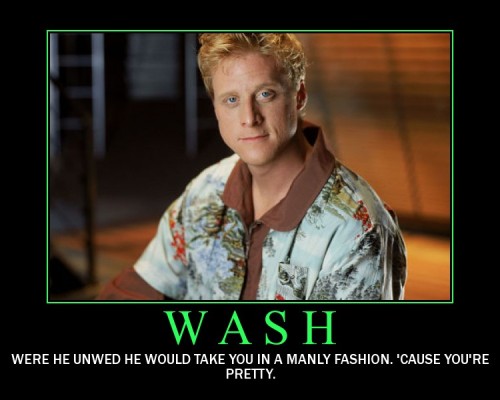
But I did have to stop and think.  Because I really did love Wash, but when he died I didn't hate Joss Whedon like I do now.  And Wash was actually the dead sort of dead that stays dead and doesn't come back next season and get his own hit spin-off.  Not to mention, I didn't hate Baz Luhrmann when Satine died in Christian's arms.  I didn't hate the writers of V for Vendetta when V died in Evie's arms.  Or any of the other people responsible for all of the other tragic stories I've watched, heard, and read through my life.  On the contrary, I've always had a strange love of melancholy.  Really, I've always preferred stories flavored with tragedy rather than comedy.

This is not unique to me.  The beauty of sadness is a western tradition.  From Oedipus Rex to Romeo and Juliet, to Titanic, western society has always had an obsession with pain and suffering and love being lost.
Interestingly, this is something rather unique to Western culture.  In traditional Chinese and Japanese stories the endings are almost exclusively happy.  Certainly there are terrible things that the hero or heroine go through, but in the end they triumph; they don't die, or go mad, or lose the most important thing in their life.  This begs the question, is our cultural obsession with tragedy something we've somehow learned/conditioned within society or is it actually part of the human condition itself?  After all, with the westernization of their society, tragedy is starting to creep into the stories being told in East (at least, that is what I've been told by people who would know).  Are we all, then, obsessed with tragedy?

What is it exactly that draws us to sad things?  In ancient Greece the first drama was tragic.  To be precise, Greek drama was born as a vehicle to achieve catharsis.  They would put on productions of these tragic plays, Oedipus, Antigone, or Achilles, where the protagonist was always subject to one tragic flaw.  No matter how noble he (or she) was, this tragic flaw would doom him to destruction.  He couldn't escape his fate and he would die, often in horrible circumstances.  The audience would watch his destruction; they would pity him and be horrified by the depth of his fall.  That was the catharsis.  The entire purpose of the play was to inspire those emotions of pity and horror in the audience, and thereby purge them, if only for a time.
I could believe that the draw of tragedy is the cathartic experience.  It is the vicarious experience of some of the most intense emotions human beings are capable of; still real, yet removed to a safe distance.  It wasn't actually your lover who was killed, but you watched her lover get killed and you imagined you were her, how you would feel, and you wept.  Except...why would you want to experience that?  Why would you seek it out?

I don't think it is simply the experience of the emotions; it is that there seems to be something beautiful in them, in the feeling of them.  We seek out these opportunities to feel the most painful emotions we posses because there appears to be some intrinsic worth in doing so.  What is it?  Think of that scene in Stranger Than Fiction, when  Doctor Hilbert has read Harold's death and he tells him he has to die.  Unfortunately, I can't find the exact quote right now, but he says something along the lines of "Everyone dies eventually Harold.  A heart attack in your bathtub in twenty years, you choke on a piece of chicken tomorrow, everyone dies.  But I guarantee, however you go, it won't be as poetic, as beautiful, or as full of meaning as what she has written for you."  While Dustin Hoffman has some insensitive moments written for laughs, this is not one of them.  Nor do we write it off as a skewed opinion from an out-of-touch professor as we do some of his other callous lines.  When Dr. Hilbert says it we mourn for Harold and his newly discovered life but we accept it.

The thing is, all people suffer.  But some people suffer with dignity and others suffer without.  Suffering without it is something to which we are all susceptible, and which we all fear.  People who cannot endure are succumbing to a weakness we all could possess.  I think that is what draws us to tragedy and that is where the cathartic experience comes in; we can't condemn the people who cannot rise to the challenge because we might not either.  But the stories of triumph are an inspiration.  They offer us a hope of what we might be. Suffering with dignity requires depth of character and maturity of mind.  People who endure something tragic are exemplifying the best of human abilities.  The beauty of sadness is in the exchange between what is and what could have been.  Pain brings out the best and worst of a person.  It is poignant and melancholy and beautiful to see failure and imagine the success that could have been.  It is inspiring, uplifting, and excruciating to see a strong bright soul punished over and over and refuse to break.  We watch and film and write and read and hear and tell these stories over and over again to see what humans are capable of.  What we think they're capable of, and what we think they aren't.  We explore the consequences at the boundaries of the human spirit and search for inspiration and consolation.

Which, I guess, leaves us at a good place to come back to where I started all of this.  My heartbreak over two fictional characters from TV shows.  I'd be hard pressed to come up with any real distinction between Rose and Angel and the rest of the tragic pantheon.  I can't rationally prove why the ending of their stories made me literally, actively angry at their writers, where other tragic stories convert me to near worship of the genius of their creators.  No rational reason.  But irrationally...I love them.  For some reason I identify and connect with their stories.  Embarrassing as it is to admit, you could easily make the argument that I no longer experience their tragedies as external performance events I sympathize with, but rather as personal losses of my own.  It isn't just the Doctor losing Rose, I lost her too.  Not only Buffy was powerless to save Angel, so was I.  And then the show goes on.  The Doctor flies away to find a new companion.  Buffy goes on to find a new vampiric lover.  Life, essentially, goes on.  Next week, same time same channel, the story continues with new characters.  In the fictional world of the story the Doctor or Buffy might have had time to mourn, but I didn't.  And if I am this crushed over fictional characters, then what hope is there for me in the real world with real loss?  Perhaps this is the root of my anger at Whedon and Davies.  They force me to admit that I may not be quite as strong as I would like to think I am.

I guess this means I've not yet experienced enough catharsis...

Sunday, February 27, 2011

An Unheard Voice

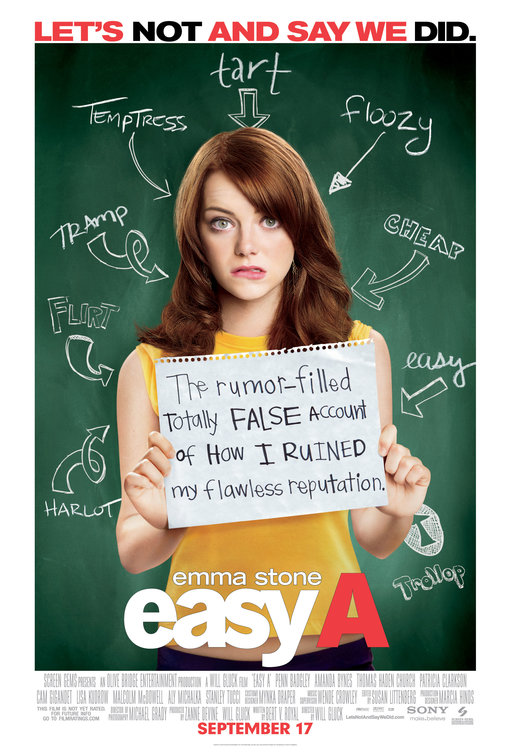
I just watched the movie Easy A.  I have mixed feelings about the movie as a whole.  Half of me loves the sass, the humor, and the independence.  The other half wonders about the morality, the rationale, and the parenting (some of which is awesome and the rest of which is…less so). 
But aside from the particular pros and cons of this movie, there was one particular thing that really bugged stood out to me—something that is merely a reiteration, recycled from a host of previous movies, TV shows, and books.  Here we have, yet again, the seemingly archetypal “Heinous Bitch Christian” (technically, if we want to include literature, this should probably be the “Heinous Bastard Christian” since it could be either male or female).  This is a stock character which is becoming, I’m very sorry to say, ever more ubiquitous in our culture.  It’s an evolution, I think, of the original “Heinous Bitch” in general.  You then got the “Heinous Bitch ‘A’ Student/Do-Gooder” from that, and now, apparently, we’ve moved to the HBC. 
What exactly is an HBC you ask?  Really?  You have to ask?  Ok, well, basically it is any overtly Christian character. ever.  Um…let’s see…there’s Mandy Moore’s character in Saved.  There’s Sarah Jessica Parker in The Family Stone.  There’s any religious character in any Chris Crutcher book ever written (oh, you don’t know who that is?  Only one of my favorite YA authors of life).  And then, of course, there is Amanda Bynes in last night’s Easy A.  Basically, this is the character that is incredibly vocal about his or her status as one of God’s Elect, and makes it his or her mission in life to judge, condemn, and persecute all the rest of the vile sinners in the world.  They are close-minded; they are stubborn; they are usually nonsensical and hypocritical; they are vindictive and persistent and utterly incapable of compromise or common sense. 
Now, I’m not naïve, I know that HBC exists as a stereotype because those people exist in real life.  I know that they are every bit as painful as they sound.  I even appreciate their comedic or dramatic value in a story.  I understand the value of depicting this sort of person both for pure dramatic effect (they function as such a very handy foil for the plucky heroine to exhibit her sass and independent thought) and for didactic value as well.  I read Staying Fat for Sarah Byrnes some time in Jr. High I believe, and the character of Mark Brittain caused me to take a very honest look at myself.  I realized that, though I didn’t ever want to be a person like Mark, without realizing it, I had developed some similar traits.  Reading Brittain’s character allowed me to correct myself.
That being said, however, I feel a very strong need to speak out against the sheer universality of this perception.  Yes, those people do exist.  But they are not the only ones out there.  Nor, I am willing to argue, are they even the majority (ok, maybe that is an optimistic statement, but I’m going to make it).  Think about it.  Christians are a group just like any and every other—comprised of a vast variety of people, each distinct and individual from the rest.  Yet somehow, it has become acceptable in today’s media to pigeonhole this entire (extremely large) demographic into an incredibly insulting caricature of itself.  Imagine, for a moment, that we did that with any other demographic.  Imagine if every Mexican you ever saw in a movie was ignorant.  What if every homosexual was a moral degenerate?  What if every black was a criminal?  Every Jew a penny-pinching cheat?  All Muslims terrorists?
Just writing those sentences made me uncomfortable, and for good reason.  While one person may possess any given assortment of faults and virtues, it is patently ridiculous to assign those same faults and virtues in the exact same proportions as a blanket across a group of people linked loosely by two or three arbitrarily selected points of correlation.  People are infinitely varied and unpredictable.  When, truly, has a stereotype really ever explained an entire demographic?  When has it ever been an effective predictor of behavior? 
Ah, you say, we can see your point as far as ethnicity or sexual orientation goes.  But how can you claim that a religion is a loose correlation?  Religion is a framework of beliefs, which consequently, act as a determiner of behavior.  Thus, a large group of people who share a religion would, logically, share behavior.  Therefore it is perfectly justifiable to condemn Christianity as a whole based on the fraction of their population who act out stupidly.  As one Christian is, so must they all be.
There are two answers to this argument, the logical and the theological.  In theory perhaps, yes, every member of a single religion should each behave exactly the same.  In any given set of circumstances any given Jew, Muslim, or Christian should react the exact same as any other given Jew, Christian, or Muslim.  Of course, the moment you make a statement like that you see how practically ridiculous it is.  No two people are precisely the same.  None of them have had the same experiences, think the same way, or are seeking the same things from life.  And those are just differences of individuals, to say nothing of differences between sects, branches, or types (though Baptists, Catholics, and Mormons each qualify as “Christians”, it is silly to imagine that the effects of each on their members are identical…the same for Shiites and Sunnis, or Orthodox, Conservative, and Reform Jews).  Suffice it to say, while at first glance it may appear as though religion ought to be a highly unifying predictor of behavior, clearly it is not. 
And as for those people who use Christianity as a reason to act out stupidly?  I would argue that these people have no idea what Christianity really is, let alone represent it as a whole.  In its deepest, most fundamental core, Christianity is a religion of love.  Christ commanded his followers to serve others and to love one another, even them that despitefully use you.  The people that you see in these movies and books have no understanding of this concept.  They are filled with hate, not love.  And that hypocrisy is not overlooked.  How often is this Christian character caught between their judgments of others and their own failure to live up to their own ideals?  Indeed, hypocrisy seems to be the reigning characteristic of the HBC.  A character who condemns everyone around him or her and then fails spectacularly in exactly the same things. 
Why does the Heinous Bitch Christian exist?  Or rather, why is it the only sort of Christian to exist in the popular media?  Why is it so impossible to create a character who is striving to truly live up to the ideals of Christianity?  A character who loves and respects those around him?  A character who understands that no one, including herself, is perfect.  A character who tries to serve others.  A character who is all of those things, and Christian.  Why does this character not exist?  Why is society quiescent as a vast slice of its population is repeatedly maligned and accused of bigotry, hatred, idiocy, and hypocrisy over and over and over again?  Why are Christians exempt from the same demands of respect that every other demographic is so justly accorded?  Yes, the Heinous Bitch Christian does exist, and will, sadly, always have a place in modern story telling.  But the true Christian exists as well.  And he deserves to have his story told as well.  She deserves a place in society.  They shouldn’t be ignored and judged unfairly simply because they don’t make a scene about it. 
So I make a request.  Don’t perpetuate the stereotype.  Make some movies where the ignorant douche bag is unaffiliated with any religion at all.  Just once, try to write a devout Christian character who is not a jerk.  Just give Christianity the respect to recognize that it contains all kinds of people, both good and bad, just like any other large group.  Please.
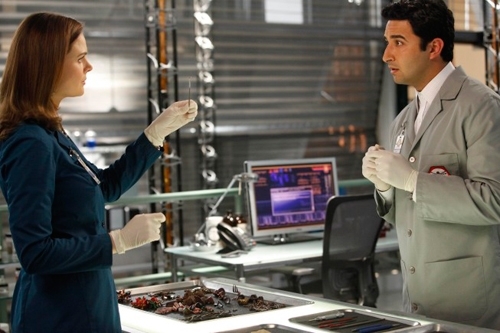
This is Arastoo Viziri, a character from Fox's "Bones".  He represents the only intelligent conservative religious character I think I've ever seen on TV.  Way to go Bones!

Friday, February 4, 2011

Impulse Control

Every Monday, Wednesday, and Friday I walk up to my 2 o'clock English Reformation class.  I walk the same way every day--out the back of the complex, across the parking lot, up the stairs, around another parking lot, and up the hill to campus.  Once on campus I walk past the Widtsoe  building, around the front of the MARB, up between the Eyering Science and the Kennedy Centres, and finally across the quad to the JFSB.  Somewhere, between the MARB and the JFSB, every Monday, Wednesday, and Friday I pass this one professor headed to class. He's a short man, I want to say not even five feet, but I'm probably not giving him enough credit.  But even more than his diminutive height, the one thing I notice about this man is his giant, bald head.  This huge, white, shining noggin attached seemingly directly to his shoulders.  There is little or no neck in evidence.

I see this man three times a week, sometimes more as he and I cross paths again returning from our respective classes.  And every time I see him, this great bald-headed man, I am overwhelmed with a desire to reach out and rub his head as I walk by, much as one might do to a statue or handrail one passes every day.  I can't tell you how very difficult it is, faced with this temptation so very often, to keep my hands resolutely in my pockets.  Every time we pass I imagine the expression I could so easily call into being on his face.  I imagine the enjoyment of an impulse, long deferred, at last fulfilled.  And I smile to myself, shove my hands deeper into my pockets, and continue walking.

Thursday, January 13, 2011

More music that ought to be listened to

If you are interested in the glorious variety of the human voice I offer you a few more choice examples.

Nina Simone's throaty melancholic voice makes this song all that it is:

I don't think that song will ever stop moving me

Then, in a wonderful example of the difference voice and arrangement can make I give you this cover of Radiohead's "Creep" by Scala, a Belgian girls' choir.  Be warned, its a Radiohead song, so there are a couple uses of the F word.


Then there is this, from the movie Bright Star

the interweaving of voices and tones is certainly as beautiful and intriguing as any instrumental orchestra could ever be.

And speaking of the intermixing of voices, listen to this song on the highest quality you can (I promise it makes a difference) and listen to how beautiful each voice individually is and then how fabulous all of them sound together.  The two tenors singing in harmony, and then that great bass coming in beneath...oh!  I could listen to this song over and over my whole life

The Grand Tradition of Boy Sopranos...

The last two periods of my "The Role Gender in Music and Theatre" class we've discussed Boy Choirs.  Apparently, in early England the boys who sang in these choirs were so in demand that there was a royal writ allowing boys to be pressed into service in the choirs with or without their (or their parents') consent.  And it is an inclination which has remained.  To this day Boy Choirs are still a revered tradition.

What is it about those voices that makes them so appealing.  You can argue that it was simply the archaic attitude toward women that initiated the practice to begin with, but that doesn't really explain it's lingering tenacity.  Once women were allowed to sing in public and particularly in religious ceremonies, why did they continue the tradition of using young boys?

I don't have any particularly "deep thoughts" on this topic.  I just think it is an interesting question.  The appeal of that piercingly high soprano is a real one, I can attest to that.  I am a person who will always choose a bass over a tenor, an alto over a soprano.  And yet, when my uncle played this for me the first time I nearly cried.
But this is a good example.  Here we have both the voice of the adult woman soprano, and the boy.  The thing is...there is a difference.  Listen to this

and then compare it to this

I certainly would never say that the second is not beautiful.  But you can hear the difference.  The woman's voice is thicker, huskier, has vibrato.  It doesn't sound as pure.  That is it, right there I think.  The purity.  These boy choirs sing almost exclusively religious songs.  That piercing, unwavering tone is the closest we can come to how we think that music should sound.  

Or maybe I am way off.  I don't know.  Mostly I just wanted to post these songs because I think they're some of the most beautiful music I've ever heard.  I hope you listen to all of them all the way through.  And on that note, here are a couple of other versions of these same songs.  This one has amazing harmonies
And while I do prefer the boy soprano singing this song, Sissel certainly does a beautiful job of it.


Saturday, January 1, 2011

Letter from the Return Desk

Dear Sir or Madam,

I know we've only just met the one time, but I really felt like I had to write you.  I was so impressed with the way, after only a few minutes, you had such amazing insight into me.  You, a complete stranger, saw me differently than my family and all of my friends...

When we first met, you seemed like anyone else.  You brought your daughter's gift in and asked to return it.  I asked you for a receipt and you informed me that your grandson's father gave it to him and he is no longer in the home.  You told me you have cancer.  You told me that you bought it from this very store but that you had a new credit card.  You told me that you already had a blu-ray player and that, having cut open the plastic wrapping, you realized that you didn't want this camera and needed to return it.  You told me you didn't have a receipt.

So I took your video game.  I scanned it in and I told you that, without any proof of purchase, I could take this pan set and give you back $26.99 for it.  I told you that normally these digital picture frames are sold for $40.

And this was when I realized that you weren't like most of the other hundreds of people I'd spoken to that day.  It became very clear that you had some insight into my character that most other people lacked.  First you showed me how poor my math skills are when you informed me that I was ripping you off for $20, when I thought it was just $12.  And that you realized I was ripping you off at all showed me just how shrewd you were.  And when I tried to apologize, an made excuses about how I had no control over the system and there was nothing I could do, you saw right through me.

You knew the truth and you told me exactly what I was.  You told me I was spiteful and malicious.  You told me I was dishonest.  You told me I was ruining your entire family's Christmas.  You told me I was evil.  I'm so impressed at how brave you were, seeing what a terrible person I am, that you could still tell me about it.  If you hadn't come along no one would ever have known what a shady individual I am.  I would have gone on fooling my co-workers and friends and family.  They all think that I'm a pretty decent person.  But you, you who had only just met me, you saw me clearly.

So, sir or madame, I just wanted to write you and congratulate you for your discernment.  I wanted to thank you for your honesty, for not letting tact or any other consideration stop you from saying what needed to be said.  Thank you for understanding that you were the only person with whom I had to deal, the only person who had a problem.  Thank you so much.

sincerely,

The girl at the return desk

Wednesday, December 8, 2010

Philosophy and Popular Culture

I researched it (via IMDB) and figured out that Napoleon Dynamite came out in the August before my Senior year of high school.  Though my dad tried to get me to go watch it in the theatre with him, I'd never heard of it so we went to see something else.  Bad decision.  I then got to spend the next 6-ish months listening to my friends quote it over and over and over until finally it came out on video and I watched it with my best friend Tonya.  I was lucky, I think, to watch it with someone who already thought it was hilarious.  Had I not, I'm not sure I would have appreciated it.  At least, not at first.  But I did, so...I did.  I, like the entire nation, was captivated by this tall, gangly, moon-boot-wearing, Jewfro'd anti-hero.
He is truly an iconic figure.  Just do an image search and look at the number of drawings, costumes, and caricatures.  And so, since he was created, I've watched with considerable interest the development of Napoleon's influence on popular culture.  Let me give you two examples.  A commercial, and this year's "epic" movie.  Stop for a moment and think...can you imagine either of those existing in pre-Napoleon society?  Since the phenomenon of Napoleon Dynamite pop culture has undergone a revolution.  The geek, the nerd, the odd-ball, and the character...they've all been glamorized and elevated to icon status.  Shows like The Big Bang Theory, Chuck, Pushing Daisies, The IT Crowd, and Community.  All of them are built around the celebration of characters who don't quite fit into the normal concept of "cool".  They're nerds and misfits.  But really...what are "nerd" and "geek" but words created to describe people who simply didn't fit the mould?


This is where I turn to philosophy.  I happen to be a huge fan of Carl Jung.  I've always been fascinated by his theories on archetypal characters (for those of you wondering where you've heard that phrase before, think this scene, at about 0:35).  Regarding art, Jung believed that there were two kinds.  There was the psychological and the visionary.  The psychological (or art pertaining to the world of human experience) he wasn't particularly interested in, and I won't waste time discussing it.  The visionary, however, was of great interest to him.  Visionary art dealt with things beyond human experience and comprehension:
It is a strange something that derives its existence from the hinterland of man's mind--that suggests the abyss of time separating us from pre-human ages, or evokes a super-human world of contrasting light and darkness.It is a primordial experience which surpasses man's understanding, and to which he is therefore in danger of succumbing.  The value and the force of the experience are given by its enormity.
The visionary artist catches a glimpse of this "unfathomed abyss".  Human experience being insufficient to explain it, he is forced to strive for something beyond human experience.  This is the point where Freud would step in and claim that these visions are the product of the artist's subconscious.  Jung, however contradicts this belief--
The truth is that it takes us away from the psychological study of the work of art, and confronts us with the psychic disposition of the poet himself...The vision is not something derived or secondary, and it is not a symptom of something else.  It is true symbolic expression--that is, the expression of something existent in its own right, but imperfectly known.
Of course, you may be wondering what all of this has to do with popular media and Napoleon Dynamite.  Stay with me, I'm getting there.


In his essay Psychology and Literature, Jung says the following:
If we consider Goethe's Faust...the question that we must answer is this:  In what relation does it stand to the conscious outlook of his time?  Great poetry draws its strength from the life of mankind, and we completely miss its meaning if we try to derive it from personal factors.  Whenever the collective unconscious becomes a living experience and is brought to bear upon the conscious outlook of an age, this event is a creative act which is of importance to everyone living in that age.  A work of art is produced that contains what may truthfully be called a message to generations of men.  So Faust touches something in the soul of every German.  So also Dante's fame is immortal, while The Shepherd of Hermas just failed of inclusion in the New Testament canon.  Every period has its bias, its particular prejudice and its psychic ailment.  An epoch is like an individual; it has its own limitations of conscious outlook, and therefore requires a compensatory adjustment.  This is effected by the collective unconscious in that a poet, a seer or a leader allows himself to be guided by the unexpressed desire of his times and shows the way, by word or deed, to the attainment of that which everyone blindly craves and expects--whether this attainment results in good or evil, the healing or an epoch or its destruction.
When Napoleon Dynamite was made, society was in the midst of one of these epochs.
Historically, he came towards the beginning of a time of huge societal change.  The digital age was undeniably in full swing, but the full significance of such an age were still being ironed out.  Web 2.0 was becoming a reality.  MySpace was at its peak, and about to begin its decline.  Facebook was still relatively unknown, limited to college students.  Google was only just beginning to claim domination of the internet from Yahoo and the already-on-the-verge-of-a-joke AOL.  You still needed an invite to use Gmail.  Twitter didn't exist.  Blogs were just starting to come into fashion (I think...I didn't have a huge internet presence back then).  The idea of social networking online--something that now seems as natural as breathing and checking facebook--was still just a hopeful glint in Mark Zuckerberg's eye.  

The realization of the true potential of the "world wide web" was finally happening.  The world was becoming truly connected.  Any information you could possibly want was just coming into the reach of your fingertips.  But ironically, with this explosion of connection came an almost paradoxical loss of identity.  Suddenly you were becoming one small grain of sand on a vast beach of other identical grains.  One friend in 637 (and that is a number on the lower side).  One tweet in a screaming crescendo.  One face in millions.  The more the connection to the world, and even just your own country...your own state...your own school, the more clearly you realized that you were a single soul amongst hundreds, thousands...billions!  What possible significance could you have?  What possible identity that wasn't the exact same as everyone else around you?

Napoleon Dynamite came at the very beginning of this revolution.  In a way, he anticipated it.  And he offered a solution to the problem.

Jung continues on in his essay to explain the inherent problems of these historical epochs.  Inevitably, they lead to imbalances in society.  As he put it "An epoch is like an individual; it has its own limitations of conscious outlook, and therefore requires a compensatory adjustment."  It is these imbalances that lead to the creation of the archetype.  

The Jungian Archetype.  This is one of my absolute favorite ideas in literary theory.  The archetype is a figure born of the collective subconscious.  The "collective unconscious" is exactly what it says--a collective pool of ideas that are universally understood while simultaneously avoiding any rigid definition.  This pool is populated by the archetype--a universally recognized figure rather akin to a Platonic form.  Think of the Hero, the Savior, the Physician, or the Mother.  These are figures recognizable even beyond cultural lines, appealing virtually universally to all mankind, but an archetype can be more societally specific.  Jung refers repeatedly to Goethe's Faust.  In the great works of visionary art an artist is tapping into this collective unconscious and finding the archetype of the age.  He cannot create anything else.  The era creates the archetype.  
It is not Goethe who creates Faust, but Faust which creates Goethe.  And what is Faust but a symbol?  By this I do not mean an allegory that points to something all too familiar, but an expression that stands for something not clearly known and yet profoundly alive. Here it is something that lives in the soul of every German, and that Goethe has helped to bring to birth.  could we conceive of anyone but a German writing Faust or Also sprach Zarathustra?  Both play upon something that reverberates in the German soul--a "primordial image,"...
More often than not, the archetype addresses some problem with the spirit of that particular Historical Epoch.
These primordial images are numerous, but do not appear in the dreams of individuals or in works of art until they are called into being by the waywardness of the general outlook.  When conscious life is characterized by one-sidedness and by a false attitude, then they are activated--one might say, "instinctively"--and come to light in the dreams of individuals and the visions of artists and seers, thus restoring the psychic equilibrium of the epoch.  
Which brings us back to Napoleon.  If you've been paying attention, you will be realizing right about now that what I am implying is that the movie Napoleon Dynamite is a piece of Great Visionary Art.  Maybe such a claim has just lost me all my credibility, but maybe not.  After all...why not?


As previously established, Napoleon came at the beginning of one of Jung's Epochs.  The homogenization of society was creating an ever greater imbalance.  The overabundance of connection and information was leading to a loss of identity and basic human awareness.  And into the breach stepped The Individual.  Quirky, odd, and independent from the demands of Homogenized Society.  In his humorously innocent exclamation "just follow your heart.  It's what I do." he offered an alternative to the culture of conformity that seemed almost inescapable.  Napoleon Dynamite became the balancing archetype to counteract the faults of this new era in history.
">


Napoleon's guileless acceptance of himself opened the door.  The way to reclaim your identity from the masses was to embrace your quirks and your eccentricities--all those things you'd previously kept so carefully hidden from the world.  In a stroke the world became intoxicated with the freedom of weirdness unleashed.


Of course, the obvious argument against this idea is that Napoleon was simply not innovative.  There were shows previously that dealt with nerds, geeks, misfits, etc.  Niche markets and cult films have always existed.  But that, I would respond, is exactly the point.  Niche markets and cult films.  Before Napoleon, the nerdier things of this world remained quietly in the back rooms of society, enjoyed by those who enjoyed them, but tacitly ignored by the greater populace.  It was Napoleon who changed that, in two ways.  First, in the creation of "Nerd Chic".  Suddenly nerdy was the new cool.  And second, in the type of dorkiness he glamorized.  It is a dorkiness made up the random, the strange, the non sequitur, but never the truly bizarre or inscrutable.


The irony is that in this instance the creation of the saving Architype was, paradoxically, the harbinger of its own doom--at least in this particular culture.  Society was hungering after a Unique Hero to save it from Identityless Homogeneity.  This Unique Hero was instantly recognized in Napoleon Dynamite.  And, having recognized him, he was then put up as the model after which a person ought to form his or her own life.  Do you see the contradiction?


The problem came in the misunderstanding of society as to what was important of this new Ideal.  People assumed that it was the form of him--his randomness, his oddness--that made him so unique.  Thus, if they adopted the same sort of eccentricities with the assumption that they, too, would then be unique.  But what Napoleon was by nature these new imitators were by art, and eccentricity is no longer eccentric when adopted by the masses.  Where Napoleon was refreshingly genuine, a movie like Scott Pilgrim is tongue in cheek, bordering on smug.  Look at how nerdy we are; look at how much random we've wedged in; look at how counter-culture we can be.  In the attempt to break out of the sameness of a homogenized worldwide culture, all we succeeded in doing was creating a new type of unvarying super-minority.
The fact remains, however, that Napoleon stood out as an Archetypal figure.  He did answer the need of society so perfectly that he couldn't help but be recognized.  So what was it that marked him out so clearly.  I would suggest that it was the function rather than the form.  Which is to say, it was his philosophies that ought to have been emulated, rather than his particular method of putting them into practice.
"Just follow your heart.  It's what I do."
These words sum up the true value of The Individual.  Napoleon wasn't trying to be random or weird.  He was being himself.  Himself just happened to be hilariously random and weird.  But rather than try to also be random and weird, perhaps our the balance our Archetypal Individual was meant to convey was simply for all of us also to be ourselves.  Not defined either by conformity or rebellion, but simply by a true knowledge of ourselves.